
The collagen supplement market is packed with powders, capsules, and blends that all promise the same results, yet most of them bury the real ingredients under sweeteners, fillers, and vague sourcing claims. If you’ve ever stood in a supplement aisle feeling more confused than confident, you’re not alone. This guide cuts through that noise. We’ll walk you through exactly what clean, grass-fed collagen does, how to prepare for a successful routine, how to dose and mix it correctly, and how to track real progress, so you can make decisions rooted in evidence rather than marketing hype.
Table of Contents
-
Troubleshooting and optimizing: Common issues and advanced tips
-
Tracking your results: What to expect and how to measure success
-
Expert perspective: What most guides miss about natural collagen
Key Takeaways
| Point | Details |
|---|---|
| Clean sourcing matters | Grass-fed, single-ingredient collagen supplements avoid additives for safer, more effective results. |
| Consistency over timing | Daily use with vitamin C is key for real skin health benefits, regardless of when you take it. |
| Start low, monitor effects | Begin with a lower dose if you have digestive sensitivities and track your progress over 8 weeks. |
| Beware of marketing hype | Simple, well-sourced collagen outperforms flashy blends or added ingredients over the long term. |
Understanding collagen: What it is and why it matters
Collagen is the most abundant protein in the human body. It forms the structural scaffolding of your skin, tendons, ligaments, cartilage, and connective tissue. Think of it as the body’s natural glue. As you age, your body produces less of it, and the collagen that remains starts to degrade faster than it’s replaced. By your mid-30s, that decline becomes noticeable in skin elasticity, joint stiffness, and slower recovery from physical stress.
Not all collagen types serve the same purpose. Type I is the most plentiful in the body and directly supports skin firmness, hair, and nail strength. Type III works alongside Type I and is especially important for skin elasticity and vascular health. For anyone focused on skin and physical recovery, these two types are the ones that matter most.
Here’s where sourcing becomes critical. The form of collagen you consume determines how much of it your body can actually use. Hydrolyzed collagen (also called collagen peptides) has been broken down into smaller amino acid chains through enzymatic processing. This makes it significantly easier for your gut to absorb compared to whole collagen protein. Hydrolyzed collagen peptides from grass-fed bovine sources, specifically Types I and III, are recommended for skin health and recovery because of their high bioavailability and clean sourcing.
Why does “grass-fed” matter beyond a marketing label? Grass-fed, pasture-raised animals produce collagen with a cleaner amino acid profile and without the residual hormones or antibiotics common in conventionally raised livestock. That distinction is meaningful when you’re consuming a product daily over months.
Key quality signals to look for when choosing collagen:
-
Single-ingredient label: The only ingredient should be hydrolyzed collagen peptides
-
Grass-fed, pasture-raised source: Verified through third-party testing or brand transparency
-
No artificial sweeteners or flavors: These add nothing to efficacy and can irritate sensitive digestion
-
No synthetic fillers or flow agents: Ingredients like maltodextrin or silicon dioxide are unnecessary
-
Third-party testing: NSF certification or equivalent adds a layer of accountability
“Randomized controlled trials confirm skin benefits from collagen supplementation, though effects are modest. Consistency matters more than timing, and pairing collagen with vitamin C and a nutrient-rich diet amplifies results.” Harvard Health
Our grass-fed collagen peptides are formulated with exactly these standards in mind, and you can explore the full range of clean supplement options to support your routine.
Preparing for success: What you need before starting
With a firm grasp on what collagen does, it’s time to prepare the essentials and avoid the biggest pitfalls before taking your first scoop.
Starting a collagen routine without the right setup is like training for a race without proper shoes. You might still finish, but you’ll leave results on the table. Before you open that first bag, gather these essentials:
-
Clean, hydrolyzed collagen powder: Grass-fed, single-ingredient, third-party tested
-
Vitamin C source: Either a whole-food source like citrus or a clean supplement
-
Water or preferred beverage: Hot coffee, tea, or smoothies all work well
-
A shaker bottle or spoon: Collagen peptides dissolve easily in most liquids
-
A consistent time slot in your day: Morning, midday, or evening, pick one and protect it
Label reading is a skill worth developing before you buy. Single-ingredient, filler-free collagen is the gold standard. Products with NSF certification or equivalent third-party verification give you documented proof that what’s on the label is actually in the product.

Comparison: Clean vs. conventional collagen
| Feature | Clean, grass-fed collagen | Conventional collagen blend |
|---|---|---|
| Source | Grass-fed, pasture-raised | Mixed or undisclosed |
| Ingredients | Single ingredient | Multiple additives |
| Third-party tested | Yes (NSF or equivalent) | Often not verified |
| Sweeteners or fillers | None | Common |
| Bioavailability | High (hydrolyzed) | Variable |
Timing is a common point of confusion. The science is clear that consistency matters far more than the specific hour you take collagen. That said, many people find morning routines easier to stick to because they can mix collagen into coffee or a morning smoothie without disrupting their day.
Pro Tip: Set a phone reminder for the same time each day during your first two weeks. Habit formation research consistently shows that time-anchored cues dramatically improve supplement adherence, especially in the early stages of a new routine.
Our filler-free collagen and broader supplement range are designed to make this preparation step as straightforward as possible.
Step-by-step: How to take collagen supplements effectively
Once your supplies are ready, the real journey starts. Here’s how to take clean collagen each day to achieve maximum results with minimal waste.
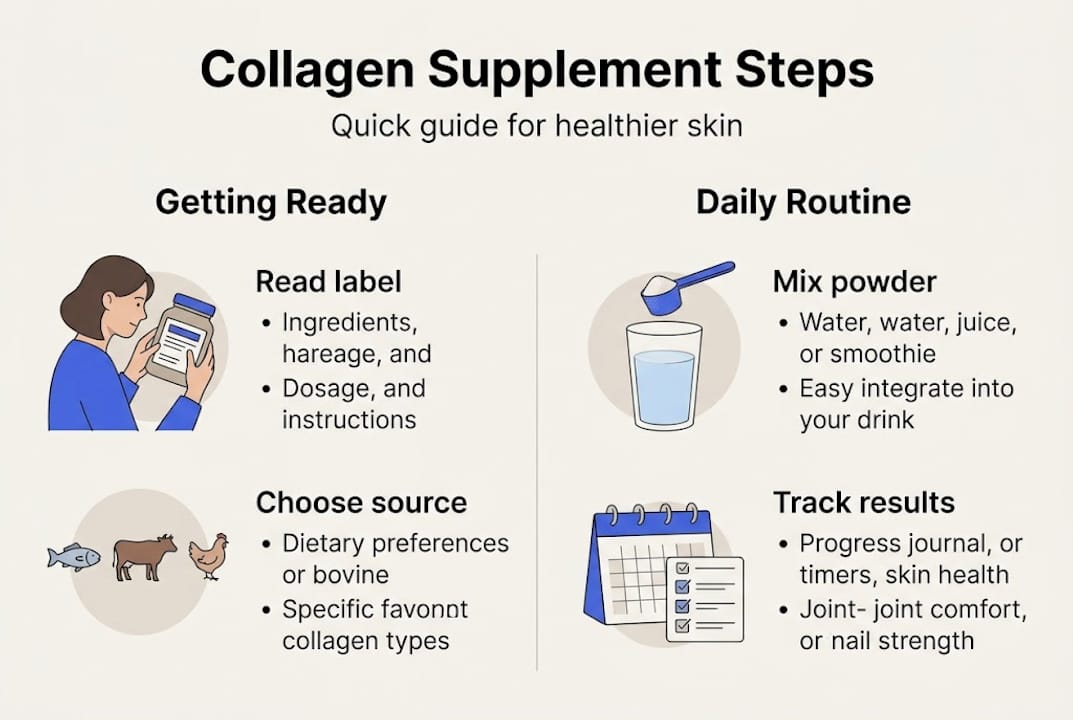
Your daily collagen routine, step by step:
-
Choose your dose based on your goal (see table below)
-
Add your collagen to 8-12 oz of liquid: Water, coffee, tea, or a smoothie all work
-
Stir or shake for 30-60 seconds until fully dissolved
-
Add your vitamin C source: Squeeze of lemon, a vitamin C supplement, or a fruit-based smoothie
-
Take it at the same time each day: Consistency is the single most important variable
-
Hydrate well throughout the day: Collagen synthesis requires adequate water intake
-
Track your intake: A simple journal or phone note keeps you accountable
Recommended daily dosage by goal:
| Goal | Daily dose | Timeline |
|---|---|---|
| Skin hydration and elasticity | 2.5 to 5 grams | 8 to 12 weeks |
| Joint recovery and mobility | 5 to 10 grams | 12 to 24 weeks |
| General connective tissue support | 10 to 15 grams | Ongoing |
Research on specific collagen peptides confirms that 2.5 to 5 grams daily supports skin elasticity and hydration, while 5 to 10 grams is more appropriate for joint recovery. Higher doses up to 15 to 20 grams are used for general connective tissue support.
Why vitamin C is non-negotiable. Collagen synthesis is an enzymatic process that requires vitamin C as a cofactor. Without it, your body cannot properly convert the amino acids proline and lysine into stable collagen fibers. Pairing collagen with vitamin C supplements or whole-food sources isn’t optional if you want full benefit from your supplement. A dose of 50 to 100mg of vitamin C alongside your daily collagen supports optimal synthesis.
Statistic: Taking 10 grams of collagen daily, paired with vitamin C, is a widely used clinical protocol for joint and skin support, based on consistent outcomes across multiple randomized trials.
Pro Tip: If you’re mixing collagen into hot coffee, the heat does not degrade the peptides. Hydrolyzed collagen is heat-stable, which makes it one of the most versatile supplements you can add to an existing morning habit.
Explore our hydrolyzed collagen peptides and pair them with collagen and vitamin C friendly options from our supplement line.
Troubleshooting and optimizing: Common issues and advanced tips
Implementing the right steps is crucial, but overcoming common bumps along the way makes the difference between giving up and seeing real results.
Even with the best collagen and a solid routine, some people hit roadblocks. Here’s how to identify and fix the most common ones.
Signs your collagen routine needs adjusting:
-
Bloating or digestive discomfort after taking collagen
-
No noticeable change after 12 or more weeks of consistent use
-
Skipping doses regularly because the routine doesn’t fit your schedule
-
Using a product with multiple ingredients that may be interfering with absorption
Low stomach acid is a real but underappreciated barrier to collagen absorption. Your digestive system needs adequate acid to break down proteins efficiently. Certain medications, particularly proton pump inhibitors (PPIs), reduce stomach acid and can impair how well your gut processes collagen peptides. If you’re on PPIs or experience frequent indigestion, start with a lower dose of 2.5 grams and increase gradually over two to three weeks.
For sensitive stomachs, taking collagen with food rather than on an empty stomach reduces the likelihood of discomfort. Adding support for sensitive digestion through magnesium glycinate can also help regulate gut motility and reduce cramping.
“While positive randomized controlled trials support collagen’s effects on skin hydration and elasticity, some researchers and regulatory bodies like EFSA flag concerns about study quality and potential industry bias. Meta-analyses, however, consistently support skin hydration and elasticity improvements with regular use.”
This is an important nuance. Not every study is created equal, and some of the most enthusiastic collagen research has been funded by supplement manufacturers. That doesn’t invalidate the findings, but it does mean you should look for independent, peer-reviewed meta-analyses rather than brand-sponsored trials when evaluating claims.
Pro Tip: If you suspect absorption issues, try taking collagen 20 to 30 minutes before a meal. This allows stomach acid to peak before the peptides arrive, which can improve breakdown and uptake without the discomfort of an empty stomach.
Supporting gut health alongside your collagen routine creates a better foundation for absorption across all your supplements, not just collagen.
Tracking your results: What to expect and how to measure success
With troubleshooting in place, let’s define success by measuring what actually works and how fast you can expect to see results based on science.
One of the biggest reasons people abandon collagen routines is unrealistic expectations. Marketing often promises visible results in days. The science tells a different story, and it’s actually a more encouraging one when you understand what’s happening at the cellular level.
Evidence-backed timelines for collagen results:
| Outcome | Expected timeline | Evidence level |
|---|---|---|
| Improved skin hydration | 4 to 8 weeks | Strong (multiple RCTs) |
| Increased skin elasticity | 8 to 12 weeks | Strong |
| Reduced fine lines | 12 to 16 weeks | Moderate |
| Joint comfort and mobility | 12 to 24 weeks | Moderate to strong |
| Sustained hydration post-washout | Weeks after stopping | Emerging |
A published randomized controlled trial found that low-molecular-weight collagen peptides at 2.5 grams daily produced a 65% improvement in skin elasticity after just 8 weeks, with sustained hydration improvements even after the supplementation period ended. That’s a meaningful benchmark for setting your expectations.
How to measure your own progress:
-
Take weekly photos in consistent lighting to track skin texture and tone
-
Use a simple 1 to 10 self-assessment for skin firmness and joint comfort each morning
-
Note energy levels and recovery time after physical activity
-
Track consistency: even two missed days per week can meaningfully slow results
Realistic expectations protect your commitment. You will not wake up with visibly different skin after two weeks. You will, if consistent, notice that skin feels more hydrated and plump by week six to eight. Fine lines take longer because collagen remodeling at the dermal layer is a slow biological process.
Statistic: The same RCT noted that skin hydration improvements persisted beyond the active supplementation period, suggesting that collagen supplementation may support lasting structural changes rather than temporary surface effects.
Pairing your internal collagen routine with topical skin support can accelerate visible results by working on the skin barrier from both inside and outside simultaneously.
Expert perspective: What most guides miss about natural collagen
Most collagen guides focus on which product to buy and how many grams to take. That’s useful, but it misses the bigger picture. The supplement industry has a talent for turning simple protocols into complicated, expensive rituals. Flavored collagen blends with adaptogens, probiotics, and added vitamins are marketed as superior, but they often just dilute the actual collagen content while adding ingredients your body doesn’t need.
The cleanest approach is also the most effective one. A pure collagen approach, meaning a single-ingredient, grass-fed hydrolyzed peptide taken consistently with a real-food diet rich in vitamin C, outperforms most premium blends in clinical settings. The reason is simple: your body doesn’t need help absorbing collagen from a proprietary blend. It needs the right amino acids, consistently delivered, in a bioavailable form.
Patience is the variable most people underestimate. The consumers who see the best results aren’t the ones who found the most sophisticated product. They’re the ones who took a clean, simple supplement every single day for three to six months without expecting a miracle in week two. Purity and discipline outperform clever marketing every time.
Ready for better results? Try clean collagen today
You now have the full framework: what collagen does, how to source it cleanly, how to dose and time it, and how to measure real progress. The next step is putting it into practice with a product you can actually trust.

At Cohld, our shop grass-fed collagen is sourced from pasture-raised animals, hydrolyzed for maximum bioavailability, and contains zero fillers, sweeteners, or synthetic additives. Every batch is produced in a GMP-compliant, US-based facility. If you’re ready to build a clean, consistent collagen routine, our supplement collection gives you everything you need in one place. Start simple, stay consistent, and let the science do the work. Visit Cohld to explore clean label nutrition built on real ingredients and real results.
Frequently asked questions
Do collagen supplements really improve skin health?
Yes. Randomized trials show meaningful improvements in skin elasticity and hydration with consistent collagen use, particularly when paired with vitamin C. Results are modest but clinically measurable.
What’s the best daily dose of collagen for skin improvement?
2.5 to 5 grams daily is the evidence-backed range for skin hydration and elasticity. Higher doses of 5 to 10 grams are better suited for joint recovery.
Should I take collagen on an empty stomach or with food?
Taking collagen with food is equally effective and gentler on digestion. Those with low stomach acid or on PPIs especially benefit from taking it alongside a meal.
How soon will I see results from collagen supplementation?
Clinical studies show measurable skin improvements in as little as 8 weeks at recommended daily doses. Skin elasticity improvements of 65% have been documented in that timeframe with consistent use.