

Most people assume that if a supplement is on the shelf, it works. But research in mice shows whole-food-based supplements enhanced mitochondrial biogenesis, enzyme activity, and physical performance more than synthetic vitamins, raising a real question about what you’re actually getting from that daily pill. The supplement industry is worth hundreds of billions of dollars, yet the gap between what’s marketed and what’s actually absorbed by your body can be enormous. This guide breaks down what makes synthetic supplements different, why health-conscious consumers are moving away from them, and how to make smarter, more informed choices for your wellness routine.
Table of Contents
Key Takeaways
| Point | Details |
|---|---|
| Natural supplements offer synergy | Whole-food-based supplements contain cofactors and supporting nutrients for better effectiveness. |
| Bioavailability matters more than source | The body’s ability to absorb and use nutrients is crucial, and specific forms often trump whether they are synthetic or not. |
| Read labels for quality | Look for certifications, transparent sourcing, and avoid additives to ensure you get a safer, more effective product. |
| Personal needs guide best choice | Genetics and health conditions mean that the right supplement choice varies from person to person. |
Setting the stage: What are synthetic supplements?
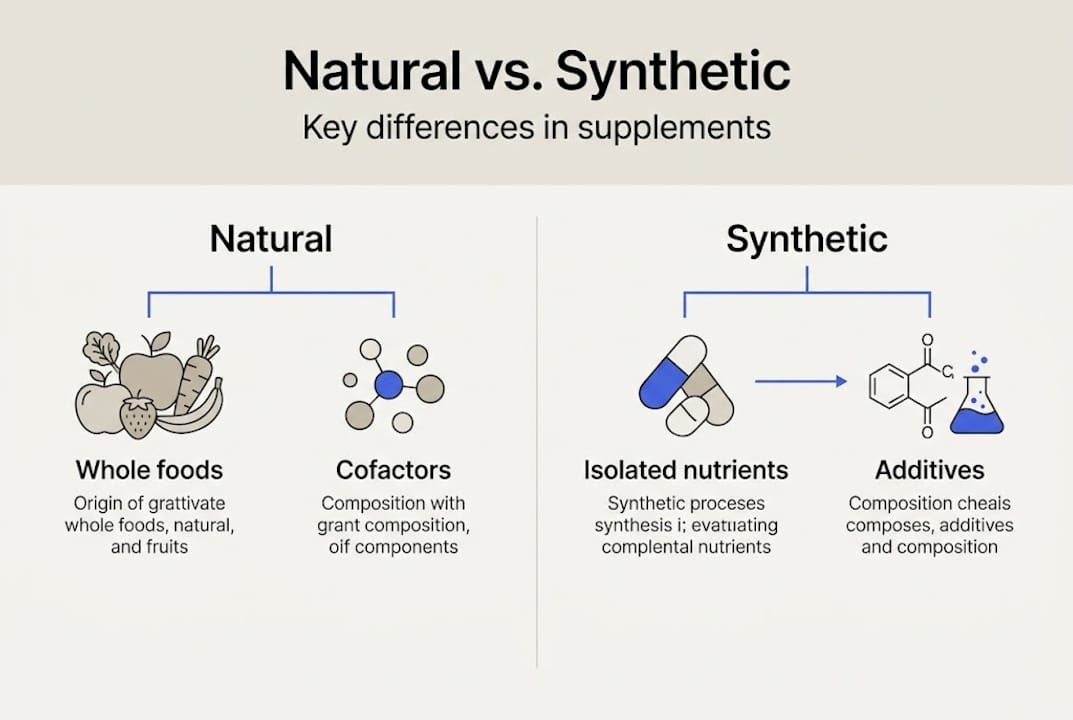
Not all supplements are created the same way, and the difference matters more than most labels let on. A synthetic supplement is one where the active nutrient is chemically manufactured in a lab, often isolated from its natural context. A natural supplement, by contrast, derives its nutrients from whole-food sources, plant extracts, or animal-based ingredients that retain their original molecular structure and accompanying compounds.
Think of it this way: vitamin C from a lab is ascorbic acid, a single isolated molecule. Vitamin C from acerola cherry comes packaged with bioflavonoids, enzymes, and trace minerals that work together in the body. Same name, very different delivery system.
Common forms of synthetic vitamins and minerals include:
-
Synthetic vitamin E (dl-alpha-tocopherol) vs. natural vitamin E (d-alpha-tocopherol)
-
Cyanocobalamin as synthetic B12 vs. methylcobalamin from natural sources
-
Folic acid as the synthetic form vs. folate (5-MTHF) from food
-
Calcium carbonate as a cheap mineral form vs. calcium from whole-food sources like algae
Mass production strongly favors synthetic forms because they are cheaper to produce, easier to standardize in dosing, and have a longer shelf life. That’s good for manufacturers, but it doesn’t always translate to better health outcomes for you.
The regulatory picture makes this even more complicated. The FDA does not pre-approve dietary supplements for safety or effectiveness, leaving manufacturers responsible for quality control. This creates real risks of contamination, adulteration, and misleading label claims in the market. When you browse our supplements collection, you’ll notice we take a very different approach: transparent sourcing, GMP-compliant manufacturing, and no synthetic fillers.
The bottom line is that synthetic supplements dominate the market not because they’re better, but because they’re cheaper and easier to produce at scale. Understanding that distinction is the first step to making smarter supplement choices.
Health impacts: Why some people avoid synthetic supplements
Understanding the types of supplements sets us up to explore why health-minded consumers might want to avoid synthetic forms. The concerns aren’t just theoretical. They’re grounded in real science and practical experience.
Bioavailability (how much of a nutrient your body actually absorbs and uses) is often lower with synthetic forms. When a nutrient is stripped from its natural matrix and isolated as a single compound, the body may not recognize or process it as efficiently. Natural supplements that come from whole-food nutrition sources often retain cofactors, enzymes, and synergistic nutrients that significantly improve absorption rates.
“Whole-food-based supplements enhanced mitochondrial biogenesis, enzyme activity, and performance more than synthetic vitamins in controlled animal studies, pointing to the power of the natural nutrient matrix.”
The concern about additives is equally important. Many synthetic supplements contain:
-
Artificial colors (FD&C dyes) with no nutritional value
-
Synthetic binders and fillers like magnesium stearate or silicon dioxide
-
Preservatives that may act as hormone disruptors
-
Proprietary blends that hide underdosed or low-quality ingredients
-
Hydrogenated oils used as coating agents in capsules and tablets
These additives don’t just take up space. Some have been linked to gut irritation, allergic responses, and interference with nutrient absorption itself. When you’re already spending money on a supplement to improve your health, the last thing you want is a filler that works against you.
Understanding bioavailability and cofactor synergy helps clarify why natural sources often outperform their synthetic counterparts in real-world use, not just in lab conditions.

Pro Tip: If you see more than five to seven ingredients on a supplement label and most of them aren’t the active nutrient, that’s a red flag. The best supplements have short, clean ingredient lists.
The shift away from synthetic supplements isn’t a trend. It’s a response to real gaps in quality, transparency, and effectiveness that health-conscious consumers are no longer willing to ignore.
Bioavailability and nutrient absorption: The real difference
With these reasons in mind, it’s critical to also understand what really determines whether your supplement will actually benefit your health: how well your body absorbs it.
Bioavailability refers to the proportion of a nutrient that enters circulation and has an active effect. It’s influenced by the form of the nutrient, the presence of cofactors, your gut health, and even your genetics. Two supplements with identical milligram doses can have wildly different effects depending on these variables.
Here’s a comparison that makes this concrete:
| Nutrient | Synthetic form | Natural/preferred form | Key difference |
|---|---|---|---|
| Vitamin D | D2 (ergocalciferol, from yeast) | D3 (cholecalciferol) | D3 raises serum levels more effectively |
| Vitamin B12 | Cyanocobalamin | Methylcobalamin | Methylcobalamin is ready-to-use; cyanocobalamin requires conversion |
| Folate | Folic acid | 5-MTHF (methylfolate) | Critical for people with MTHFR gene variant |
| Vitamin E | dl-alpha-tocopherol | d-alpha-tocopherol | Natural form has higher biological activity |
The vitamin D example is particularly well-documented. Vitamin D3 raises and maintains serum levels significantly better than D2, which is the synthetic form derived from yeast. This isn’t a minor difference. Studies show D3 can be up to 87% more effective at raising blood levels than D2, which matters enormously if you’re supplementing to correct a deficiency.
Here’s how to think about bioavailability when choosing supplements:
-
Identify the form on the label. Look beyond the nutrient name to the specific chemical form listed.
-
Research conversion requirements. Some forms require your body to convert them before use. If your body struggles with that conversion, you lose most of the benefit.
-
Consider your genetics. Genetic SNPs (single nucleotide polymorphisms, meaning inherited gene variations) can significantly affect how you process certain nutrient forms, particularly folate and B12.
-
Factor in your gut health. Compromised gut lining reduces absorption of many nutrients regardless of form.
-
Look for enhanced delivery systems. Some natural supplements use liposomal or fermented forms to boost absorption further.
Pro Tip: If you take turmeric for inflammation, the form matters enormously. Our turmeric and curcumin supplement is formulated for enhanced absorption because curcumin on its own has notoriously poor bioavailability without the right delivery system.
The takeaway here is nuanced but important: “natural” vs. “synthetic” is a useful starting framework, but the specific form of each nutrient is what ultimately determines how much benefit you get.
The role of cofactors and synergy in natural supplements
Beyond bioavailability, another major advantage of natural supplements is the existence of natural cofactors and synergistic compounds. This is where whole-food-based nutrition really pulls ahead.
A cofactor is a substance that works alongside a primary nutrient to help it function properly. In nature, nutrients rarely exist in isolation. Vitamin C in food comes with bioflavonoids. Iron in meat comes with heme protein structures that dramatically improve absorption. Vitamin K2 works alongside vitamin D3 to direct calcium to bones rather than arteries.
When you take a synthetic, isolated nutrient, you often miss these cofactors entirely. The result can be a nutrient that’s technically present in your bloodstream but not fully utilized because it’s missing its natural partners.
Key benefits of cofactor-rich, natural supplements include:
-
Better absorption without needing high doses
-
Reduced side effects because nutrients are processed more naturally
-
Broader health impact from synergistic compounds working together
-
Lower risk of nutrient imbalances caused by taking isolated high-dose synthetics
-
More predictable outcomes aligned with how your body evolved to process food
The genetic angle adds another layer. People with MTHFR gene variants (a common genetic SNP affecting folate metabolism) or other absorption issues benefit significantly more from active, natural nutrient forms. For these individuals, synthetic folic acid can actually accumulate unmetabolized in the blood, which is counterproductive and potentially harmful.
Statistic to know: Estimates suggest that up to 40% of the population carries at least one MTHFR gene variant, meaning a substantial portion of supplement users may be getting far less from synthetic B vitamins than they think.
Synthetic B12 in the form of cyanocobalamin requires a conversion step in the body to become usable methylcobalamin. For people with absorption issues or certain genetic variants, that conversion fails, rendering the supplement nearly useless. This is exactly why we built our explore supplements range around active, bioavailable forms rather than cheap synthetic alternatives.
Exploring our nutrition collection gives you a clear picture of what it looks like when cofactor synergy is built into every product from the ground up, rather than treated as an afterthought.
The “one-size-fits-all” supplement model is fundamentally broken. Natural, cofactor-rich options respect the complexity of human biochemistry in a way that isolated synthetics simply cannot.
How to choose safer, more effective natural supplements
Understanding the science is important, but what really matters is how to put this knowledge into practice when you’re shopping for supplements. Here’s a practical framework you can use immediately.
-
Read the ingredient list, not just the front label. Marketing claims on the front of a bottle mean nothing. Flip it over and read every ingredient, including the “other ingredients” section where fillers and additives hide.
-
Look for specific nutrient forms. Methylcobalamin over cyanocobalamin. D3 over D2. 5-MTHF over folic acid. Magnesium glycinate over magnesium oxide. The form tells you far more than the dose.
-
Avoid artificial colors and synthetic dyes. There is no health reason for a supplement to be bright red or blue. These are purely cosmetic and signal low-quality manufacturing priorities.
-
Be skeptical of proprietary blends. When a label says “proprietary blend 500mg” without listing individual doses, it’s often a sign that the most expensive ingredients are underdosed.
-
Check for third-party testing. Look for certifications from NSF International, USP, or Informed Sport. These indicate independent verification of what’s actually in the product.
-
Prioritize transparent sourcing. Brands that tell you exactly where their ingredients come from, whether grass-fed, pasture-raised, or certified organic, are far more trustworthy than those that don’t.
The regulatory gap is real and worth repeating. Since the FDA does not pre-approve dietary supplements for safety or effectiveness, the responsibility of quality control falls entirely on manufacturers. That means your job as a consumer is to verify, not assume.
Pro Tip: Search for a brand’s Certificate of Analysis (COA) before buying. A COA is a document from a third-party lab confirming that the product contains what the label claims and nothing harmful. Reputable brands make these available on request or on their website.
When you shop natural supplement options, prioritize brands that lead with transparency, not just marketing language. The difference between a supplement that works and one that doesn’t often comes down to these details.
Our view: When “natural” is worth it and when it’s not
Having explored the technical and practical reasons behind the natural supplement movement, here’s our honest take: the natural-versus-synthetic debate is real, but it’s also sometimes oversimplified.
Not every synthetic nutrient is subpar. High-quality synthetic forms of certain nutrients, particularly methylated B vitamins like methylfolate and methylcobalamin, are actually the preferred choice for many people, including those with MTHFR variants. In these cases, the “synthetic” label is misleading because these forms mirror what the body needs most.
Where natural whole-food supplements consistently win is in the broader picture. When a nutrient comes embedded in its natural matrix, with cofactors, enzymes, and synergistic compounds intact, the body responds more holistically. You get fewer side effects, better utilization, and outcomes that align more closely with what ancestral diets provided.
Our position is this: the best supplement strategy is personalized, not dogmatic. Start with whole-food-based options wherever possible. When a specific clinical need calls for a precise synthetic form, use the highest-quality version available. And always prioritize brands that find quality supplements through transparent sourcing and third-party testing over those chasing the lowest cost per capsule.
Black-and-white thinking in nutrition rarely serves anyone well. The goal is to make the most informed choice for your specific body and goals.
Explore clean, natural supplements for holistic wellness
If this article has shifted how you think about what goes into your daily supplement routine, you’re already ahead of most consumers.

At Cohld, every product in our lineup is built around the principles we’ve covered here: bioavailable nutrient forms, whole-food sourcing, zero synthetic fillers, and full transparency from farm to capsule. Whether you’re looking for collagen peptides from grass-fed animals, magnesium glycinate for sleep and recovery, or NAD+ for cellular energy, you’ll find clean options that actually work with your body. See all natural products or go straight to browse supplements to find what fits your wellness goals.
Frequently asked questions
Are all synthetic supplements bad for you?
Not all synthetic supplements are harmful; their safety and effectiveness depend on the form, quality, and your individual needs, and some forms like D3 raise serum levels more effectively than others regardless of their origin.
Can I get the same benefits from synthetic supplements as from natural ones?
Some nutrients in synthetic form are less bioavailable, but others, if properly formulated, can be just as effective; nutrient form matters more than the natural-versus-synthetic label alone.
How do I know if a supplement is synthetic or natural?
Read the label for ingredient sources; whole-food-based or plant-extract terms signal natural origins, while chemical names like cyanocobalamin, dl-alpha-tocopherol, or folic acid are typically synthetic isolates.
Is it safer to take only FDA-approved supplements?
The FDA does not pre-approve dietary supplements for safety or effectiveness, so it’s essential to research brands independently and look for third-party testing certifications rather than relying on regulatory approval.