

Most people shopping for supplements assume “natural” means safe and effective while “synthetic” means risky and inferior. That assumption drives billions in purchasing decisions every year, and it gets the picture wrong more often than it gets it right. The real difference between natural and synthetic supplements runs deeper than sourcing, touching molecular structure, manufacturing quality, and what’s actually verified on the label. Understanding these distinctions will help you spend smarter and protect your health rather than just follow marketing language.
Table of Contents
- Regulations and definitions: what the law actually says about supplements
- Molecular and biological differences between natural and synthetic forms
- Safety and quality issues: manufacturing matters more than source
- The gray area: compounded wellness peptides and safety warnings
- Making informed choices: practical tips for supplement buyers
- Why focusing on quality over origin is the future of supplements
- Explore clean, verified supplements for your wellness journey
- Frequently asked questions
Key Takeaways
| Point | Details |
|---|---|
| Regulation focus | Dietary supplements are regulated based on ingredient type and labeling, not natural vs synthetic origin. |
| Molecular form matters | Different chemical forms, like vitamin E stereoisomers, impact potency and absorption. |
| Quality over source | Manufacturing quality and contaminant testing are more important than whether supplements are natural or synthetic. |
| Caution with peptides | Wellness peptides often lack safety data and can pose risks regardless of being natural or synthetic. |
| Smart shopping | Choose supplements by verified purity, exact form, and third-party testing instead of marketing labels. |
Regulations and definitions: what the law actually says about supplements
Before you can evaluate any natural vs synthetic supplements claim, you need to know what a supplement even is under U.S. law. The answer might surprise you.
Under the Dietary Supplement Health and Education Act, supplements are defined by their ingredients and labeling intent, not by whether those ingredients came from a plant, an animal, or a laboratory. That means the FDA does not distinguish between “natural” and “synthetic” as regulatory categories. A product can be fully synthetic and still carry a dietary supplement label. The law covers:
- Vitamins and minerals
- Herbal extracts and botanicals
- Amino acids
- Concentrates and metabolites
This matters because many consumers trust the “natural” label as a kind of regulatory endorsement. It isn’t. The FDA regulates manufacturing standards and marketing claims, not the source of the ingredients. For a closer look at how this plays out in practice, the supplement regulation insights at Cohld break down what these distinctions mean for real purchasing decisions.
The takeaway: the label “natural” reflects a marketing choice, not a legal guarantee of purity, potency, or safety.
Molecular and biological differences between natural and synthetic forms
Here’s where the differences in supplement sources get genuinely interesting and genuinely important.

Natural and synthetic versions of the same vitamin can have different molecular shapes, known as stereoisomers. Your body processes these shapes differently. The classic example is vitamin E. Natural d-alpha tocopherol and synthetic dl-alpha tocopherol differ in stereochemistry, which changes how efficiently your tissues absorb and use them. The natural “d-” form is generally recognized as more biologically active per milligram than the synthetic “dl-” form, which is actually a mix of eight different stereoisomers.
| Feature | Natural vitamin E (d-alpha) | Synthetic vitamin E (dl-alpha) |
|---|---|---|
| Stereoisomers | 1 (active form) | 8 (mixed activity) |
| Biological activity | Higher per mg | Lower per mg |
| Label indication | “d-alpha tocopherol” | “dl-alpha tocopherol” |
| Dosage equivalence | 1 mg = 1.49 IU | 1 mg = 1.10 IU |
| Typical cost | Higher | Lower |
This doesn’t mean natural is always better across every nutrient. Synthetic folic acid, for example, is actually more bioavailable than the folate found in most foods. Synthetic creatine monohydrate is one of the most studied and effective forms of any supplement, full stop.
Key takeaways when reading labels:
- Look for the specific chemical form, not just the nutrient name
- Check for “d-” vs “dl-” prefixes on fat-soluble vitamins
- Compare dosage units carefully (mg vs IU can mask potency differences)
- Understand that modern science in supplements often closes the gap between natural and synthetic forms
Pro Tip: When two products list the same vitamin at the same dosage, check the chemical form. You may be comparing apples to oranges in terms of actual potency delivered to your cells.
Safety and quality issues: manufacturing matters more than source
If molecular form is the hidden variable in potency, manufacturing quality is the hidden variable in safety. And this is where the natural vs chemical supplement debate gets genuinely dangerous if misunderstood.
9 to 15% of tested supplements were found to contain undeclared or prohibited substances in a 2026 systematic review, and this contamination risk applied regardless of whether the product was marketed as natural or synthetic. Weight-loss products and bodybuilding formulas showed the highest rates, but the “natural” label offered zero protection.
Some “natural” supplements have been found to contain potent pharmaceutical stimulants hidden behind botanical names. That’s not a minor labeling issue. That’s a serious public health risk wearing a wellness costume.
What actually reduces risk:
- GMP certification (Good Manufacturing Practices): confirms facilities meet production and testing standards
- Third-party testing: independent labs like USP, NSF, or Informed Sport verify what’s actually in the bottle
- Certificate of analysis (COA): documents batch-specific testing results
- Transparent sourcing: knowing where and how ingredients are produced
When choosing clean supplements, these markers matter far more than whether the ingredients came from a plant or a reactor.
Pro Tip: A USP or NSF verification seal on the label means an independent party confirmed the product’s identity, strength, and purity. That single signal beats “all-natural” marketing language every time.
The gray area: compounded wellness peptides and safety warnings
Peptides are a growing category where the difference between natural and synthetic supplements becomes almost meaningless, and where the risks are highest.
Many wellness peptides like BPC-157 are marketed as natural because they mimic compounds found in the human body. But they are synthesized in labs with widely varying quality controls, and almost none have completed the human clinical trials required to establish safe dosing. ECRI and ISMP have explicitly warned that compounded wellness peptides lack clinical evaluation and carry serious purity risks, including contamination with heavy metals.
“Patients using wellness peptides have no reliable information about whether they are safe or effective.” — ECRI and ISMP joint safety alert, 2025
What you need to know about this category:
- Peptide “natural vs synthetic” labels are essentially meaningless for safety evaluation
- Purity varies dramatically between manufacturers and batches
- No FDA-approved pathway exists for most of these compounds as supplements
- Consulting a licensed healthcare provider before use is not optional here
For a grounded view of clean supplements and peptide warnings, verified sourcing and regulatory compliance are the only rational starting points.
Making informed choices: practical tips for supplement buyers
Now that you understand the regulatory gaps, the molecular complexity, and the safety data, here’s how to translate that knowledge into smarter buying.
Step-by-step approach for evaluating any supplement:
- Identify the exact chemical form of the key ingredient (not just the nutrient name)
- Check whether a third-party verification seal is present (USP, NSF, Informed Sport)
- Confirm GMP compliance from a U.S.-based or equivalent facility
- Read through the inactive ingredients for synthetic fillers, artificial colors, or undisclosed additives
- Cross-reference the dose against clinical research, not just the recommended daily value
Additional things worth watching for:
- “All-natural” or “chemical-free” claims carry no legal weight and serve as marketing, not safety information
- Proprietary blends often hide individual ingredient doses, making potency comparison impossible
- For choosing clean supplement ingredients, transparency about sourcing and standardization matters more than buzzwords
- Avoiding synthetic fillers in formulas reduces unnecessary chemical load regardless of the core ingredient’s origin
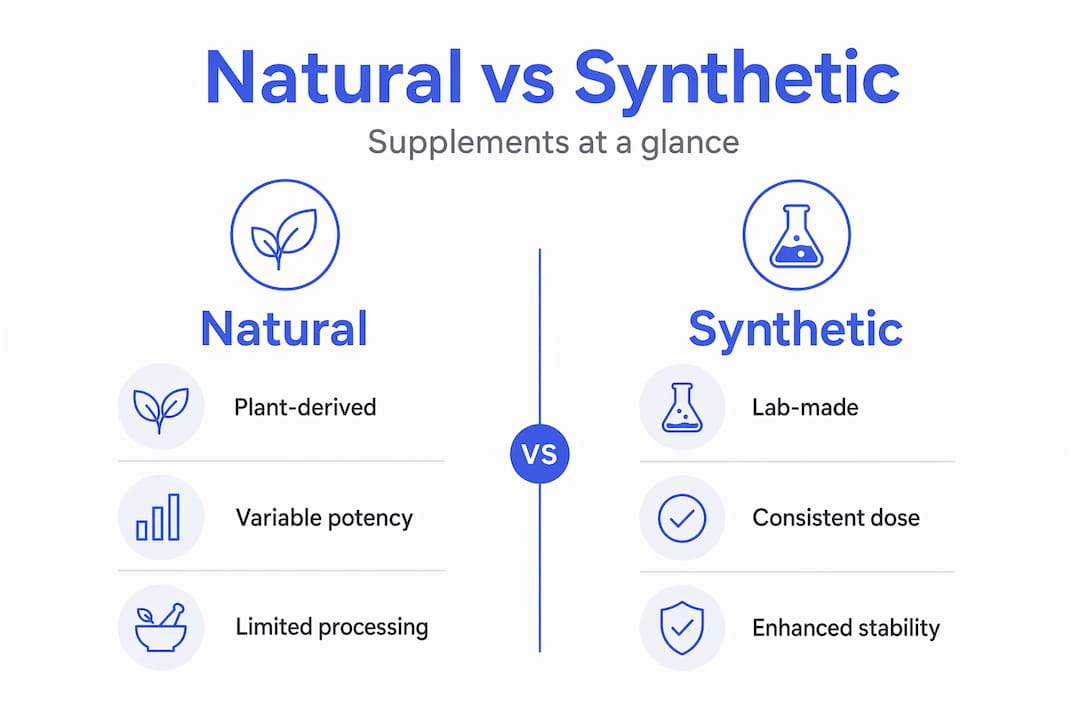
| Factor | Natural supplements | Synthetic supplements |
|---|---|---|
| Bioavailability | Variable, form-dependent | Often highly consistent |
| Cost | Generally higher | Generally lower |
| Potency consistency | Batch-to-batch variation possible | Highly standardized |
| Environmental impact | Lower when ethically sourced | Depends on production method |
| Contamination risk | Present without rigorous testing | Present without rigorous testing |
Supplement decision-making guided by verified ingredient forms and clinical evidence consistently outperforms decisions made on source stories and label aesthetics.
Pro Tip: For supplements you take long-term, verified potency and batch consistency matter more than whether the ingredient came from a plant or a lab. Consistency compounds over months. Uncertainty does too.
Why focusing on quality over origin is the future of supplements
The natural vs synthetic debate has been running for decades, and it has distracted consumers from the questions that actually determine health outcomes. We’ve seen it repeatedly: a beautiful “all-natural” product with zero third-party testing and inconsistent batch quality, sitting next to a precisely dosed synthetic form with full documentation. The synthetic wins for the health-conscious consumer every time, not because synthetic is better in principle, but because the quality controls are documented.
The uncomfortable reality is that low-quality products cause more harm than synthetic origin ever could. A contaminated “natural” herbal supplement is not safer than a clean, verified synthetic vitamin. What determines supplement safety and performance is chemical identity, label accuracy, and contaminant screening, not the story on the front of the box.
We think the future of smart supplementation looks like this: consumers who ask for a certificate of analysis before buying, who know the difference between d-alpha and dl-alpha tocopherol, and who treat “all-natural” as a prompt to dig deeper rather than a reason to stop reading. That’s not idealism. That’s where the evidence points.
The brands worth trusting are the ones that give you that information without being asked. For a sharper take on clean supplements perspective, the standard should always be verifiable quality over compelling origin stories.
Explore clean, verified supplements for your wellness journey
At Cohld, we built our entire approach around the insight this article is grounded in: that quality, transparency, and verification beat source stories every time. Every product in our lineup is formulated without synthetic fillers, sourced from grass-fed or pasture-raised animals where applicable, and produced in GMP-compliant U.S. facilities.

Whether you’re looking for collagen peptides, magnesium glycinate, creatine, or NAD+, you’ll find clear ingredient labeling, third-party testing commitments, and no marketing fluff. Browse our full clean supplements collection, explore vitamins and supplements with detailed sourcing information, or see the complete product range to find what fits your health goals. You now know what to look for. We make sure it’s there.
Frequently asked questions
Are natural supplements always safer than synthetic ones?
No. Safety depends far more on manufacturing quality, purity verification, and ingredient form than on whether a supplement is natural or synthetic. Contamination risks occur across both categories equally.
What does “natural” on a supplement label actually mean?
It typically means the ingredient was derived from a plant, animal, or whole food source with minimal chemical modification, but it carries no regulatory definition and does not guarantee safety or potency. Natural sourcing alone tells you little about effectiveness.
How can I tell if a supplement contains the effective form of an ingredient?
Look for specific chemical names on the label, including stereochemical indicators like “d-” or “dl-” for vitamin E. The molecular forms and dosage conversions listed by clinicians give you a reliable reference point for comparison.
What are the risks of buying wellness peptides from online vendors?
Most compounded wellness peptides lack adequate human safety data and have documented purity issues, including heavy metal contamination. ECRI and ISMP warn that consumers have no reliable way to assess their safety or effectiveness.
What should I look for to confirm a supplement’s quality?
Prioritize third-party verification seals (USP, NSF, Informed Sport), GMP manufacturing compliance, a clear and complete ingredient list, and batch-specific testing documentation. USP verification confirms identity, strength, and purity independently of the manufacturer’s own claims.