

Maca root has built a loyal following among people looking for natural ways to boost energy and reclaim hormonal balance. The Andean root vegetable, consumed for thousands of years in the Peruvian highlands, gets credited with everything from reducing menopause symptoms to lifting mood and firing up libido. Those are compelling promises. But the controlled science tells a more layered story, one where symptom improvements are real yet hormone blood levels often stay unchanged. Understanding that gap is exactly what will help you make smarter choices about whether maca deserves a place in your daily routine.
Table of Contents
- What do maca supplements claim to do?
- Scientific evidence: What do controlled studies reveal?
- Hormonal balance and energy: What’s really happening?
- Safety, fit, and choosing ancestral-derived maca
- A fresh perspective on maca: beyond the hype
- Explore clean, ancestral-derived supplements
- Frequently asked questions
Key Takeaways
| Point | Details |
|---|---|
| Subjective benefits dominate | Maca is linked to improvements in symptoms like mood and sexual function rather than measurable hormone changes. |
| Safety needs attention | Not everyone should use maca—those with hormone-sensitive cancers or medication concerns must consult a professional. |
| Choose quality sources | Select supplements with clean, ancestral-derived ingredients and transparent sourcing. |
| Energy effects modest | Evidence for energy enhancement is limited and mostly based on self-reported improvements. |
What do maca supplements claim to do?
Walk through any natural health store or browse supplement sites and you will quickly spot a common pattern. Maca is positioned as a do-it-all root: an energizer, a hormone regulator, a libido booster, and a mood lifter all in one small capsule or powder scoop. These claims are not invented out of thin air. They reflect real experiences that real people report. But they are worth examining carefully before you assume the mechanism is what the marketing implies.
The most frequent claims you will see include:
- Natural energy enhancement without stimulants like caffeine
- Hormonal balance for women navigating perimenopause and menopause
- Improved libido and sexual function in both men and women
- Mood and psychological support, especially reduced anxiety and depression scores
- Fertility support, particularly relevant for men
The hormone-balance claim deserves the closest attention. According to WebMD’s review, consumer beliefs that maca directly “balances hormones” are better described as symptom changes rather than reliable, measurable shifts in sex-hormone blood levels. That distinction matters enormously. Feeling better and having objectively different estrogen or testosterone readings are two completely different outcomes.
If you are exploring maca root benefits for the first time, keeping that distinction front of mind will save you from both disappointment and from overcrediting a supplement that may still genuinely improve your quality of life.
Now that we have set the stage, let’s look at what the science actually says about maca’s effects.
Scientific evidence: What do controlled studies reveal?
Controlled clinical trials are the clearest lens we have for separating real effects from placebo. When it comes to maca, the picture is genuinely interesting, partly because subjective outcomes and objective hormone markers point in different directions.
| Study type | Population | Dose | Key finding |
|---|---|---|---|
| Randomized, double-blind, crossover trial | Postmenopausal women | 3.5 g/day for 6 weeks | Improved mood and sexual function scores; no change in estradiol, FSH, LH, or SHBG |
| Animal study (2025) | Male dogs | 75 mg/kg oral black maca | Higher serum testosterone; improved semen quality and storage stability |
| Survey-based observational data | General adults | Varied | Self-reported energy and mood improvements |
The human trial result is the most striking. In a rigorous randomized, double-blind, placebo-controlled crossover study in postmenopausal women, serum estradiol and FSH did not differ between maca and placebo groups. Yet those same women reported meaningfully better psychological symptom scores and improved sexual dysfunction ratings. The supplement worked, just not the way most people assume.
The animal data offers a contrasting signal. A 2025 study in male dogs found that oral black maca supplementation at 75 mg/kg was associated with higher serum testosterone and better semen quality. Animal studies can not be directly mapped onto human physiology, but they suggest the testosterone story may be species-specific or dose-dependent in ways that human trials have not yet fully captured.
Key takeaway: Maca’s effects in humans appear to work through indirect pathways, possibly involving mood-regulating compounds or adaptogenic activity, rather than by directly raising or lowering sex hormones.
Pro Tip: If you are using maca to support athletic recovery, pair it with a complete recovery strategy. The science of natural supplements shows that single-ingredient approaches rarely carry the full load. Read about athletic recovery strategies to see how maca fits alongside other evidence-supported tools.
With the scientific results in mind, it’s time to address why “hormone balance” claims remain popular despite the evidence.
Hormonal balance and energy: What’s really happening?
The phrase “hormonal balance” has become one of the most overused and least defined terms in wellness marketing. It sounds precise, but it rarely refers to a specific, measurable outcome. Understanding what it actually means, or doesn’t mean, protects you from making supplement decisions based on vague promises.
Here is a clear comparison of what maca studies have actually shown versus what many marketing messages imply:
| Outcome category | What marketing claims | What controlled evidence shows |
|---|---|---|
| Estrogen levels | “Balances estrogen naturally” | No significant change in blood estradiol in human trials |
| Mood and anxiety | “Supports emotional wellbeing” | Measurable improvement in psychological symptom scores |
| Libido and sexual function | “Restores sexual vitality” | Reported improvement in sexual dysfunction scores |
| Energy | “Boosts energy without stimulants” | Subjective self-report improvement; limited objective data |
| Testosterone (men) | “Raises testosterone” | Some animal evidence; human data is less conclusive |
The LWW menopause trial found no measurable changes in circulating sex-hormone markers. That aligns with WebMD’s assessment that hormone-balance claims reflect symptom patterns rather than reliable blood-level shifts.
What this means practically is worth spelling out:
- Feeling less anxious or more energized after taking maca is a real and valid experience
- That experience does not confirm your estrogen or testosterone has changed
- Maca likely works through other mechanisms, possibly involving glucosinolates or its adaptogenic properties
- Chasing blood-marker changes with maca may set you up for unrealistic expectations
If you want to explore the full range of supplement options available, approaching each product with this same level of critical thinking will serve you far better than trusting label claims at face value.
Beyond the benefits, responsible use requires understanding maca’s safety profile and limitations.
Safety, fit, and choosing ancestral-derived maca
Most healthy adults tolerate maca well. It has been a dietary staple in the Andes for centuries, consumed in large amounts as food. That long track record gives it a meaningful baseline of safety that many newer synthetic compounds simply do not have. Still, there are real cautions worth knowing.

WebMD flags specific concerns around maca for people with hormone-sensitive cancers and for those taking multiple medications, noting that evidence for long-term safety in these groups remains limited. Pregnant and nursing women are also advised to check with a healthcare provider before use.
Here is a practical checklist if you are evaluating maca for your routine:
- Assess your health context. If you have a hormone-sensitive condition, discuss maca with your doctor before starting.
- Start low. Traditional doses in trials range from 1.5 to 3.5 grams per day. Begin at the lower end.
- Choose clean sourcing. Ancestral-derived maca, grown in high-altitude Peruvian conditions without synthetic pesticides, preserves the natural compound profile that gives the root its character.
- Verify GMP compliance. A product manufactured in a GMP-certified, US-based facility carries a baseline of quality assurance.
- Avoid proprietary blends that obscure dosing. You should know exactly how much maca you are getting per serving.
- Expect weeks, not days. Most trials used 6-week or longer protocols. Give it time before drawing conclusions.
Pro Tip: Gelatinized maca is easier on the digestive system than raw maca powder because the starch has been broken down. If raw maca gives you bloating or discomfort, switching to the gelatinized form often resolves that quickly.
Now let’s see how these insights reshape our perspective on maca’s role in modern supplement routines.
A fresh perspective on maca: beyond the hype
Here is what we think gets missed most often in maca conversations: the insistence on hormone-level proof is actually the wrong standard for many supplements. Symptoms are data. When postmenopausal women in a rigorously controlled trial consistently report better mood and sexual wellbeing compared to placebo, something real is happening even if a blood test doesn’t explain it. We do not fully understand every mechanism behind every plant compound. That is not a reason to dismiss the effect.
At the same time, there is a real danger in letting marketing hijack legitimate outcomes. When a brand calls maca a “hormone balancer,” it implies a precision and mechanism that the current evidence does not support. That framing sets up consumers to expect bloodwork changes they are unlikely to see, and to feel deceived when they don’t get them.
Our perspective, grounded in watching modern supplement science evolve alongside ancestral wisdom, is this: quality-of-life improvements are worth pursuing. They are not second-class outcomes. If maca supports your mood, your energy, and your sense of wellbeing, that is a meaningful result. Hold on to it. Just do not mistake it for confirmed hormonal reprogramming.
The most honest thing we can tell you is to keep maca in its proper lane. It is a nutrient-dense, historically consumed root with real quality-of-life data behind it. It is not a pharmaceutical hormone therapy. Used with clean sourcing, realistic expectations, and appropriate safety screening, it can be a genuinely valuable part of a natural health routine.
Explore clean, ancestral-derived supplements
If this article has clarified what maca can realistically offer, the next step is finding a product you can actually trust. Most of the noise around maca comes from formulations loaded with fillers, undisclosed sourcing, and vague dosing. That is exactly what we set out to change at Cohld.

Our approach starts with ancestral wisdom and finishes with modern quality controls. If the afternoon slump is what sent you looking at maca in the first place, Bedrock works the same problem from a different angle: shilajit, ashwagandha, tongkat ali and sea moss in one capsule a day, made in a GMP-compliant US facility with no synthetic fillers. If you want to see the full picture of what clean supplementation looks like, browse supplements across our range. We also carry a curated selection of nutrients when you explore vitamins and supplements, all built on the same foundation of purity and transparent sourcing.
Frequently asked questions
Does maca actually alter hormone levels?
Most controlled human studies show that maca does not significantly change blood estrogen or testosterone levels. In a key postmenopausal trial, estradiol, FSH, and LH were unchanged despite meaningful symptom improvements.
What are the main benefits of maca supplements?
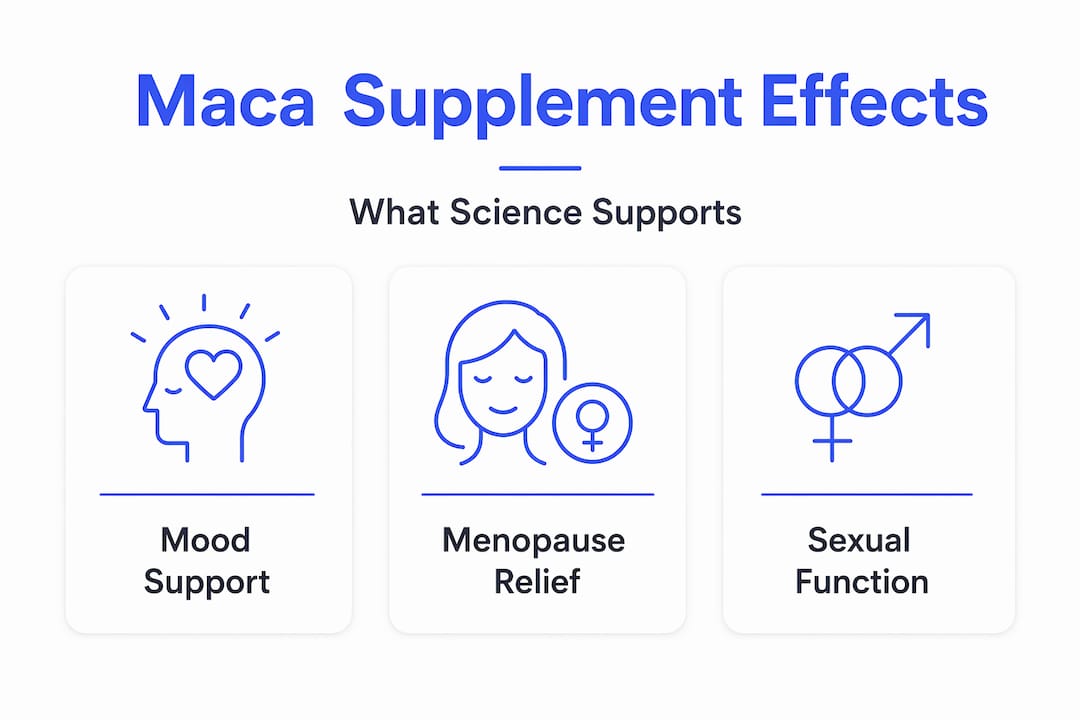
Maca shows the most consistent evidence for mood support, reduced anxiety, improved sexual function scores, and menopause-related symptoms. Users reported improved psychological symptoms and better sexual wellbeing versus placebo in the strongest trial available.
Is maca safe for everyone?
Maca is not suitable for everyone. WebMD cautions that people with hormone-sensitive cancers or those on multiple medications should consult a healthcare provider before use, as long-term safety data remains limited.
How should I choose a maca supplement?
Look for products with clearly disclosed Peruvian-sourced maca, no synthetic fillers, GMP-certified manufacturing, and a transparent per-serving dosage. Gelatinized forms are easier to digest for most people.
Does maca help with energy?
Controlled evidence for objective energy enhancement is modest at best. Most benefits in trials were subjective quality-of-life outcomes; the strongest controlled evidence focused on menopause and sexual function endpoints, not performance metrics.