
Most health-conscious shoppers assume “Made in USA” on a supplement label means every ingredient was grown, raised, and processed on American soil. It rarely does. Understanding why purchase US-sourced supplements matters, and what that label actually guarantees, is the difference between buying with confidence and paying a premium for impressive packaging. This guide breaks down the regulatory standards, the ingredient quality questions most brands avoid, and the practical steps you can take right now to verify what you’re actually putting in your body.
Table of Contents
- Understanding what “Made in USA” means for supplements
- Why source supplements from US-based manufacturers for safety and quality
- The role of ingredient sourcing: grass-fed, pasture-raised, and natural purity
- How to verify US sourcing and quality claims before you buy
- Practical benefits of choosing US-sourced supplements for your health and skin
- The hidden truth about supplement sourcing and what most brands won’t tell you
- Discover clean, US-sourced supplements at Cohld for natural wellness
- Frequently asked questions
Key Takeaways
| Point | Details |
|---|---|
| FTC standards govern ‘Made in USA’ | Supplements must meet strict laws requiring most ingredients and processing to be US-based for unqualified ‘Made in USA’ labels. |
| US manufacturing means higher safety | FDA’s cGMP enforcement ensures US-made supplements follow rigorous quality and contamination controls. |
| Ingredient origin affects quality | Grass-fed, pasture-raised, and natural sourcing improve supplement purity and benefits for wellness and skin. |
| Verify claims proactively | Consumers should check third-party tests, audit reports, and labeling qualifiers before trusting US-sourcing claims. |
| Transparency beats patriotic marketing | True quality depends on openness about sourcing and quality systems, not just patriotic branding or labels. |
Understanding what “Made in USA” means for supplements
Before you can make a smart buying decision, you need to know what the label on your bottle legally means, because it’s almost certainly not what you think.
The Federal Trade Commission sets the standard for “Made in USA” claims in the US. Their rule is strict on paper: all significant processing and virtually all ingredients must be US-sourced for a product to carry an unqualified “Made in USA” claim. The key word is “virtually all,” which the FTC interprets as leaving no room for significant imported content.
Here’s where it gets complicated. Most supplement companies source raw materials like herbal extracts, amino acids, and vitamins from overseas manufacturers, then blend, encapsulate, and bottle them in a US facility. That process qualifies as domestic manufacturing under some interpretations, but it does not meet the FTC’s unqualified standard. Brands that use this language anyway risk civil penalties exceeding $53,000 per violation, with recent enforcement actions reaching into the millions.
The labeling landscape breaks down like this:
- “Made in USA”: Requires all or virtually all ingredients and processing to be domestic. The gold standard.
- “Assembled in USA”: Final product put together in the US, but ingredients can come from anywhere.
- “Made in USA from global components”: A qualified claim that is legally honest but signals significant imported content.
| Label claim | US ingredient requirement | US processing required | Level of transparency |
|---|---|---|---|
| Made in USA (unqualified) | All or virtually all | Yes | Highest |
| Assembled in USA | None | Final assembly only | Low |
| Made in USA from global components | Partial | Yes | Moderate |
| No country-of-origin claim | None | Not disclosed | None |
Understanding this table alone puts you ahead of most supplement buyers. If a brand uses patriotic imagery but a qualified claim in fine print, that tells you everything. For a deeper look at why ingredient integrity matters, avoiding synthetic supplements is a useful place to start.
Why source supplements from US-based manufacturers for safety and quality
A US address on the bottle matters. What matters more is whether that facility operates under rigorous, enforceable standards.

US supplement manufacturers must comply with FDA Current Good Manufacturing Practices, known as cGMP, codified under 21 CFR Part 111. These regulations govern everything from raw material testing to equipment sanitation to batch documentation. The FDA has intensified cGMP enforcement heading into 2026, with a sharp focus on contamination control, quality systems, and documentation integrity. That means US-based facilities face real consequences for cutting corners in ways that overseas suppliers simply don’t.
Here’s what strong US manufacturing actually provides:
- Documented supplier vetting: US firms are required to test incoming raw materials for identity and purity before production begins.
- Autonomous Quality Units: The FDA requires a separate quality team with the authority to reject production batches, independent of business pressure.
- Shorter supply chains: Fewer transit stops mean less exposure to moisture, heat, and contamination before ingredients reach production.
- Traceable documentation: Batch records in US facilities allow for fast, reliable recalls when something goes wrong.
Pro Tip: When evaluating a brand, ask directly whether their Quality Unit has the authority to halt production. If a company can’t answer that question, they likely don’t have one worth mentioning.
For consumers committed to choosing clean supplements, US-based manufacturing under FDA oversight is the foundation, not the ceiling.
The role of ingredient sourcing: grass-fed, pasture-raised, and natural purity
You can have perfect manufacturing and still end up with a subpar supplement if the raw ingredients are poor quality. This is where most conversations about US sourcing stop too early.
Grass-fed and pasture-raised sources produce measurably different ingredients. Collagen peptides from grass-fed cattle carry better amino acid profiles and fewer residual hormones than conventionally raised sources. Consumers prioritizing grass-fed ingredients report better outcomes for skin elasticity, joint recovery, and overall vitality, and the science supports cleaner input producing cleaner output.
Three specific advantages of grass-fed and pasture-raised ingredients stand out:
- Enhanced omega profiles: Pasture-raised animals produce ingredients with healthier omega-3 to omega-6 ratios compared to grain-fed equivalents, which matters for inflammation and skin health.
- Reduced toxin load: Animals raised on pasture accumulate fewer synthetic hormones, antibiotics, and pesticide residues, which transfer directly to the final supplement.
- Stronger sustainability case: US pasture-raised sourcing supports regenerative farming practices that improve soil health and reduce chemical runoff.
US farming regulations also apply here. American agricultural standards limit hormone use and pesticide exposure in ways that many overseas supply chains do not match. This is why “natural” on a label is not enough. Look for specific sourcing language, certifications, and clean supplement ingredients transparency before you buy.
Pro Tip: Third-party testing results should be available on request or published online. If a brand lists “grass-fed collagen” but can’t produce a Certificate of Analysis showing heavy metal and contaminant testing, the sourcing claim is unverified.
How to verify US sourcing and quality claims before you buy
Labels are marketing. Documentation is truth. Here’s exactly what to check before committing to any supplement brand.
Most supplements labeled “Made in USA” are assembled or packaged domestically using imported raw materials. That means verification can’t stop at the front of the bottle.
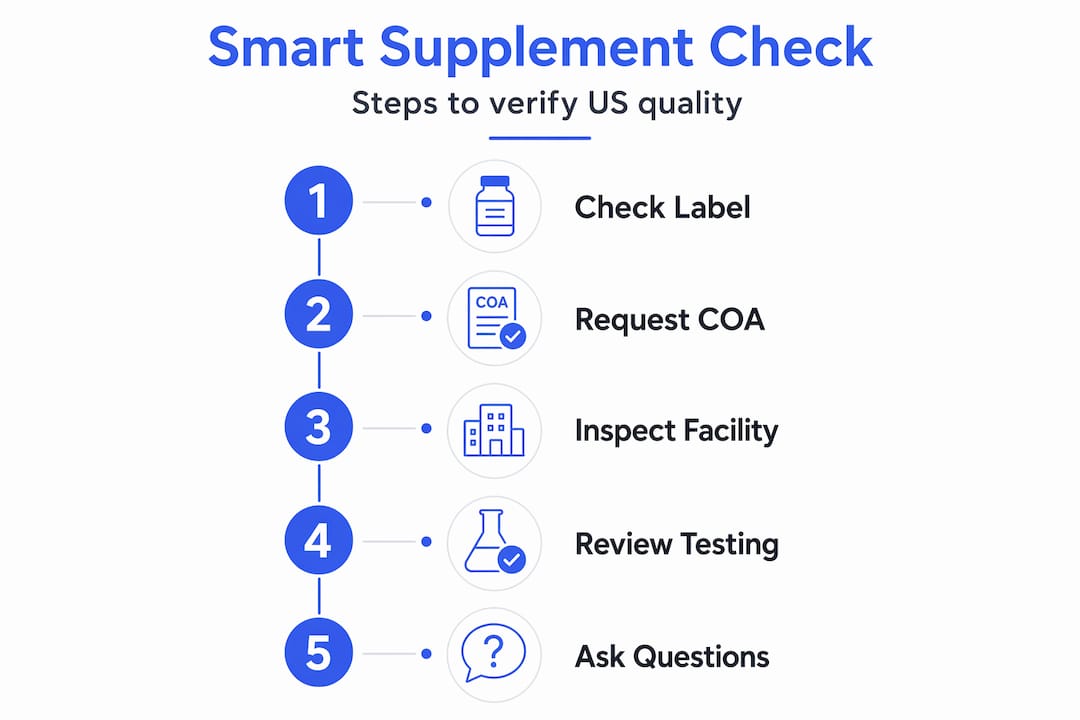
Follow these steps:
- Read the label carefully: Does it say “Made in USA” outright, or is there a qualifier in smaller print? The distinction is legally significant.
- Request a Certificate of Analysis (COA): A legitimate COA covers identity, potency, heavy metals, and microbial testing from an independent third-party lab. No COA means no verification.
- Check FDA compliance: Look for explicit references to 21 CFR Part 111 cGMP compliance and ask whether the facility has undergone recent FDA inspections.
- Look for recognized quality seals: USP Verified, NSF Certified for Sport, and ConsumerLab approval indicate independent quality testing.
- Ask about ingredient origin directly: Reputable brands will tell you where their collagen, creatine, or magnesium comes from. Vague answers are a red flag.
| Verification step | What it confirms | Where to find it |
|---|---|---|
| COA review | Potency, purity, contaminants | Brand website or direct request |
| FDA inspection record | Facility compliance | FDA.gov database |
| Quality seal check | Independent testing | USP, NSF, ConsumerLab websites |
| Label language review | Legal sourcing claims | Product label |
Use this clean supplement checklist as a starting point when vetting new brands.
Practical benefits of choosing US-sourced supplements for your health and skin
The reasons to trust US brands go beyond regulatory boxes checked. There are real, tangible outcomes for your body.
US consumers associate domestic sourcing with safety and quality, particularly after high-profile import contamination incidents involving heavy metals and undisclosed pharmaceutical compounds in foreign-made supplements. That association isn’t just perception. It reflects a track record.
Specific benefits include:
- Fresher ingredients: Shorter supply chains mean less time between production and your bottle, preserving potency.
- Faster recall capability: Traceable US supply chains allow contaminated batches to be identified and pulled within days, not months.
- Better skin health support: Clean, high-quality collagen and tallow-based skincare products from grass-fed US sources deliver nutrients in forms your skin can actually use.
- Support for domestic agriculture: Buying US-sourced supplements puts money into regenerative farming operations that improve land quality over time.
“70 to 80% of American consumers prefer domestic products, especially supplements, specifically because of safety concerns tied to import contamination and labeling transparency.”
These aren’t abstract benefits. If you care about what goes into your body and how it affects your skin and energy over time, explore natural skin health supplements grounded in traceable, clean sourcing.
The hidden truth about supplement sourcing and what most brands won’t tell you
Here’s something the supplement industry rarely admits out loud: a truly fully US-sourced supplement is genuinely rare. Most brands source at least some ingredients overseas because domestic production of certain amino acids, botanical extracts, or vitamins simply doesn’t exist at commercial scale in the US. That’s not a scandal. But hiding it behind a flag is.
The FDA does not pre-approve dietary supplements before they hit shelves. That’s a fact most consumers don’t realize. It means manufacturer quality systems are what actually stand between you and a contaminated or underdosed product. The regulatory framework matters, but the company’s internal culture matters just as much.
What this really means is that transparency is a more reliable signal than patriotic branding. A brand that tells you exactly where its grass-fed collagen comes from, publishes its COAs, and describes its Quality Unit’s authority is more trustworthy than one with a flag on every page and no documentation available.
The brands worth buying from are the ones that treat sourcing disclosure as a feature, not a liability. That’s the standard we hold ourselves to when building products that why clean supplements matter for long-term health.
Pro Tip: Ask any supplement brand you’re considering this exact question: “Can you tell me the country of origin for your top three ingredients?” Their response will tell you everything about their transparency culture.
Discover clean, US-sourced supplements at Cohld for natural wellness
With a clear picture of what “US-sourced” really means and how to verify it, the next step is finding products that actually meet the standard.

At Cohld, every product in the US-sourced supplements collection is built around grass-fed, pasture-raised ingredients, sourced and manufactured under strict GMP-compliant standards with full ingredient transparency. From collagen peptides and creatine to magnesium glycinate and NAD+, every formula is free from synthetic fillers, artificial additives, and hormone disruptors. Third-party testing results are available so you can verify what you’re buying before you commit. Browse our full range of quality vitamins and supplements, or explore the complete lineup of natural skincare and supplements designed to support your skin, recovery, and long-term vitality.
Frequently asked questions
What does “Made in USA” mean for dietary supplements?
It legally means the supplement’s final assembly, significant processing, and nearly all ingredients must originate in the United States, meeting the FTC’s strict standard of “all or virtually all” domestic sourcing and manufacturing.
Are all “Made in USA” supplements fully made with US ingredients?
No. Most supplements labeled “Made in USA” are assembled or packaged domestically but contain imported raw materials, so only a small number actually meet the full US sourcing requirement.
Why is US manufacturing considered safer for supplements?
US manufacturing is subject to FDA cGMP regulations and intensified inspections that require thorough quality systems and contamination controls, which directly reduces the risk of adulterated or mislabeled products reaching consumers.
How can I verify if a supplement is truly US-sourced and high quality?
Look for qualified label claims, request third-party COAs covering purity and potency, check FDA inspection records, and confirm the brand discloses specific ingredient origins rather than using generic patriotic language.
What benefits do grass-fed and pasture-raised ingredients provide in supplements?
They offer enhanced nutrient profiles, fewer contaminants, and better support for wellness and skin health because grass-fed and pasture-raised sourcing produces cleaner, more bioavailable ingredients than conventional farming methods.