

You spend real money on supplements, swallow them faithfully every morning, and feel… nothing. No extra energy. No clearer thinking. No improvement at all. The problem usually isn’t the supplement itself. It’s bioavailability. This step by step guide to bioavailable supplements will show you exactly how to choose, time, and combine nutrients so your body actually absorbs what you’re paying for. The difference between a supplement that works and one that doesn’t often comes down to form, timing, and gut context — not just what’s on the label.
Table of Contents
- Key Takeaways
- What bioavailability actually means for your supplements
- Before you start: laying the right foundation
- How to choose and use bioavailable supplements step by step
- Common mistakes that kill your results
- How to measure whether your supplements are working
- My take on what actually changes the game
- Clean supplements built for real absorption
- FAQ
Key Takeaways
| Point | Details |
|---|---|
| Form determines absorption | Choose active forms like methylfolate and magnesium bisglycinate instead of synthetic alternatives. |
| Timing changes everything | Fat-soluble vitamins need food; iron absorbs better on an empty stomach. |
| Gut health is the gatekeeper | A compromised gut will limit absorption no matter how clean your supplement is. |
| Retest after 8 to 12 weeks | Biomarker retesting after 8-12 weeks is the only reliable way to confirm a supplement is working. |
| Labels can mislead you | Total compound weight and actual elemental dose are two different numbers — and only one matters. |
What bioavailability actually means for your supplements
Bioavailability is the percentage of a nutrient that enters your bloodstream and becomes available for your body to use. A capsule that contains 500 mg of a mineral doesn’t mean 500 mg reaches your cells. The absorbed fraction can be dramatically lower depending on the form, your digestive health, and what else you consumed at the same time.
Here’s where most people misunderstand the concept: bioavailability isn’t a fixed number for any given nutrient. No standardized clinical definition exists for bioavailability in dietary supplements, which means quality varies wildly across products. Folic acid, for example, requires conversion in your body before it becomes usable. People with MTHFR genetic variants convert it poorly. Methylfolate, the active form, skips that step entirely.
Several factors shape how much of a supplement you actually absorb:
- Formulation: Chelated minerals, liposomal delivery, and active vitamin forms absorb at higher rates than standard oxide or synthetic versions.
- Digestive health: Low stomach acid, compromised bile production, or gut inflammation all reduce absorption capacity.
- Nutrient interactions: Calcium and magnesium compete for the same absorption pathways. Taking them together at the same time cuts what you get from both.
- Timing relative to meals: Fat-soluble vitamins (A, D, E, K) need dietary fat to absorb properly. Water-soluble nutrients generally don’t.
- Genetic factors: Polymorphisms like MTHFR affect how well you convert certain synthetic forms to usable ones.
The takeaway is simple. More milligrams on the label does not mean more benefit in your body.
Before you start: laying the right foundation
Skipping this preparation step is the most common reason supplementation fails. You need to understand your baseline before adding anything to your routine.
Start with food. Guidelines recommend getting at least 50% of micronutrients from whole foods because they come packaged with cofactors that boost absorption. No supplement replicates the synergy of a nutrient-dense meal. Supplements close gaps. They don’t replace foundational nutrition.
Your gut is the actual gateway for everything you take. Chronic stress, antibiotic use, and a low-fiber diet all degrade the gut lining and reduce enzyme activity. If your gut isn’t in decent shape, even the most bioavailable supplement in the world will underperform. Consider adding fermented foods, fiber, and a quality probiotic before or alongside your supplement protocol.

Get tested before you supplement blindly. A standard blood panel can reveal deficiencies in vitamin D, B12, ferritin, magnesium, and zinc. Without that data, you’re guessing. And optimizing bioavailability requires tailoring to your digestive health, genotype, and existing nutrient status — not following a generic protocol.
Pro Tip: Ask your healthcare provider for a full micronutrient panel, not just a standard metabolic panel. You want actual numbers, not just “within normal range,” because the optimal range and the clinical range are often very different.
- Prioritize whole foods as your nutritional base before reaching for any pill.
- Check gut health before expecting supplements to perform.
- Test biomarkers before you begin, so you have a real baseline to compare against.
How to choose and use bioavailable supplements step by step
Four critical layers determine supplement performance: form, elemental dose, timing, and sequence. Work through each layer deliberately.
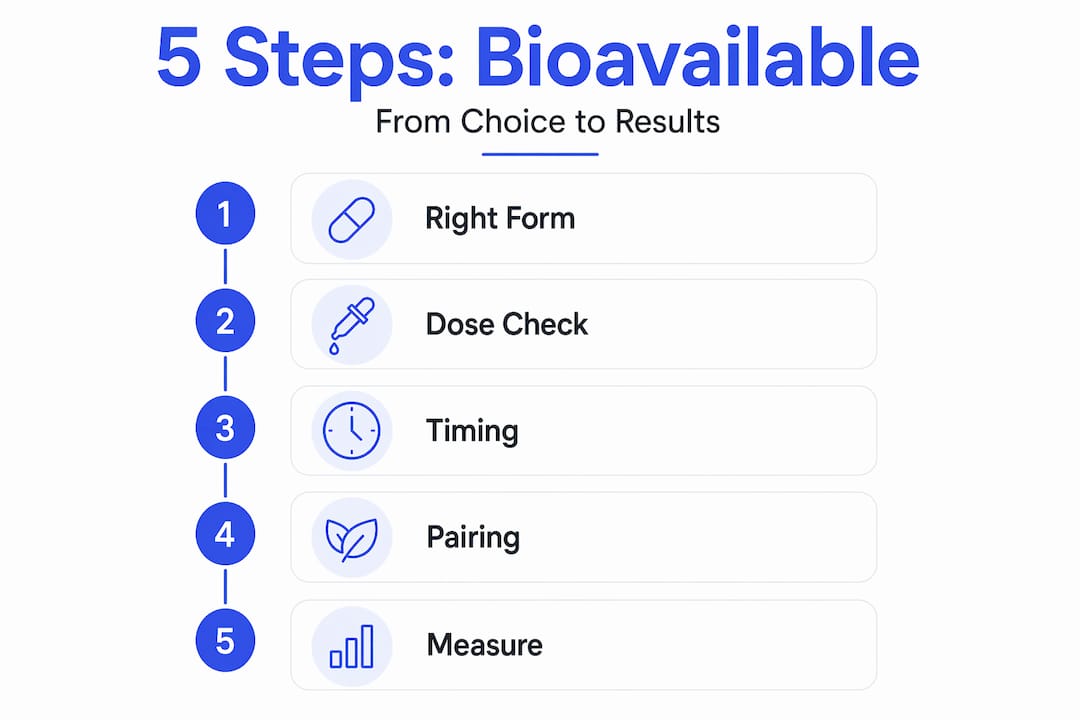
Step 1: Choose the right form. This is the single biggest lever you have. Magnesium glycinate or bisglycinate absorbs far better than magnesium oxide. Methylcobalamin outperforms cyanocobalamin for B12. Active forms like 5-MTHF matter especially for people with conversion issues. When in doubt, look for the word “methyl,” “glycinate,” “bisglycinate,” or “liposomal” on the label. These signal higher bioavailability. You can also review Cohld’s natural supplement guide for a breakdown of categories and their absorption profiles.
Step 2: Read elemental doses, not total compound weight. Magnesium oxide is poorly absorbed, and labels listing 500 mg of magnesium oxide are not giving you 500 mg of usable magnesium. The elemental magnesium content is a fraction of that. Always find the “elemental” amount listed in parentheses on the supplement facts panel. That’s your real dose.
Step 3: Time your supplements correctly. Vitamins D, A, E, and K need fat to absorb, so take them with your largest meal. Timing and meal context dramatically affect absorption for nearly every fat-soluble nutrient. Iron, on the other hand, absorbs better on an empty stomach, away from calcium. B vitamins are best taken in the morning since they support energy metabolism.
Step 4: Avoid antagonistic combinations. Calcium and magnesium compete for the same transporters. Zinc and copper inhibit each other at high doses. Separate these by at least two hours. Pair enhancers together: vitamin C boosts iron absorption, and vitamin K2 partners with vitamin D3 for calcium metabolism.
| Supplement pairing | Effect on absorption |
|---|---|
| Vitamin D3 + K2 + fat | Synergistic; K2 directs calcium from D3 properly |
| Iron + vitamin C | Vitamin C increases iron absorption significantly |
| Calcium + magnesium (same time) | Competitive; reduces absorption of both |
| Zinc + copper (high doses, same time) | Inhibitory; take separately or balance ratios |
Step 5: Consider advanced delivery when standard forms fall short. Nanocarrier-based delivery enhances stability, protects nutrients from degradation, and improves intestinal uptake for vitamins D, A, E, K, B12, C, and folate. Liposomal vitamin C and D are practical examples already on the market.
Pro Tip: Build your supplement stack in layers. Start with foundational nutrients (vitamin D, magnesium, omega-3, B12) for the first four weeks. Only add targeted extras like NAD+ or collagen peptides once your foundation is stable.
Common mistakes that kill your results
Even well-intentioned supplementation goes wrong. These are the patterns worth watching for:
- Ignoring timing rules. Supplement efficacy is commonly hindered by ignoring timing and interactions. Taking iron with your calcium supplement at breakfast is a classic example of two nutrients canceling each other out.
- Buying synthetic forms. Folic acid, cyanocobalamin, and magnesium oxide are cheaper to manufacture and routinely land in low-cost multivitamins. They are not equivalent to their active counterparts. Read Cohld’s breakdown of why synthetic supplements underperform to understand exactly what you’re avoiding.
- Overlooking gut health. A leaky gut, low bile production, or chronic inflammation creates a ceiling on absorption. The best supplement in the world hits that ceiling if digestion is compromised.
- Misreading labels. Total compound weight misleads. Elemental dose is what counts.
- Never retesting. Without retesting, you have no idea whether a supplement is working. Subjective feelings are unreliable for nutrients like vitamin D or magnesium, which improve cellular function quietly over time.
How to measure whether your supplements are working
The clearest signal that a supplement is working isn’t how you feel in week two. It’s what your bloodwork shows at week 10.
Consistent daily use needs 8-12 weeks before biomarker levels stabilize enough to retest reliably. Plan your protocol around that timeline. Start, hold steady, test again.
Track both objective markers and subjective ones. A few to monitor:
- Vitamin D: Serum 25(OH)D level. Target 40 to 60 ng/mL for most adults.
- Magnesium: Red blood cell magnesium is more accurate than serum magnesium.
- B12: Serum B12 plus homocysteine levels together give a clearer picture.
- Cognitive function: Daily multivitamin use is linked to roughly 2 years of slower brain aging in adults over 45 per the 2026 COSMOS trial. This benefit doesn’t show up on a scale or in the mirror, but it’s real.
Adjust your protocol based on what the data shows. If levels haven’t moved, the form, dose, or timing needs to change — not just the brand.
My take on what actually changes the game
I’ve watched people spend hundreds of dollars a month on supplements that do essentially nothing because they picked the cheapest form, swallowed everything at once with coffee, and assumed the label told the whole story. It doesn’t. The supplement industry has a labeling problem, and most consumers don’t know what to look for.
What I’ve found consistently is that switching one variable — the form of a single nutrient — can produce results that months of the standard version never achieved. Moving someone from magnesium oxide to magnesium glycinate often resolves sleep issues within two weeks. That’s not a minor tweak. That’s the entire outcome.
The effective use of supplements isn’t just about ingredients. Delivery format, cofactor pairing, timing, and gut environment all shape whether you get a result or an expensive placebo. I also think most people underestimate how much individual genetics matter. MTHFR variants are far more common than the average person realizes, and they make synthetic B vitamins functionally useless for a significant portion of the population.
Think critically. Personalize your choices. Test, adjust, and don’t assume that what works for someone else will work for you.
— Justin
Clean supplements built for real absorption

The principles in this guide only deliver results if the supplements themselves are formulated with bioavailability in mind. Cohld builds every product around that standard, sourcing from grass-fed, pasture-raised animals and avoiding synthetic fillers, artificial additives, and anything that compromises absorption. Products like magnesium glycinate, collagen peptides, and NAD+ are selected specifically because they exist in forms your body can actually use without conversion barriers. Explore Cohld’s full supplements collection to find options that match what you’ve learned here. As always, consult your healthcare provider before starting any new supplement protocol, especially if you have existing medical conditions.
FAQ
What does bioavailability mean in supplements?
Bioavailability is the percentage of a nutrient that actually enters your bloodstream and becomes usable after you take it. The amount listed on a label and the amount your body absorbs are often very different numbers.
Which supplement forms are the most bioavailable?
Active or chelated forms consistently absorb better: methylfolate over folic acid, magnesium glycinate over magnesium oxide, and methylcobalamin over cyanocobalamin. Liposomal delivery also significantly improves absorption for vitamins C and D.
How long does it take for bioavailable supplements to work?
Most biomarker improvements require 8 to 12 weeks of consistent daily use before they are detectable in blood tests. Some effects, like improved sleep from magnesium glycinate, may appear sooner.
Can I take all my supplements at once?
Not ideally. Calcium and magnesium compete for absorption, and iron is blocked by calcium. Spreading supplements across morning and evening, and pairing them correctly with or without food, significantly improves how much your body actually uses.
Do I need to test my nutrient levels before supplementing?
Yes. Testing before you start gives you a real baseline, allows you to identify actual deficiencies, and lets you track whether your protocol is producing results after the 8 to 12 week retesting window.