
Most supplements on store shelves look legitimate. Clean packaging, confident claims, and a long ingredient list that reads like a wellness manifesto. But the signs of pure supplements go far deeper than what any brand chooses to print on its label. The FDA does not pre-verify supplements before they reach you, which means the burden of verification falls on you. This guide cuts through the noise and gives you specific, reliable signals to tell real purity from marketing theater.
Table of Contents
- Key takeaways
- 1. Third-party certifications are the clearest sign of purity
- 2. Vague label claims are a red flag, not a selling point
- 3. Recent recalls signal serious purity failures
- 4. Adulteration in specific supplement types is more common than you think
- 5. Purity extends to how a supplement is manufactured
- 6. Cross-contamination and undeclared substances are hidden purity risks
- 7. A practical checklist for identifying pure supplements
- My honest take on supplement purity standards
- Clean supplements built on real purity standards
- FAQ
Key takeaways
| Point | Details |
|---|---|
| Certifications are the gold standard | Look for USP, NSF, or ConsumerLab seals as primary proof of independent purity testing. |
| Labels can mislead you | Proprietary blends and vague “natural” claims are not substitutes for transparent ingredient disclosure. |
| Recalls reveal real risks | Recent contamination events show that even popular vitamins can fail purity standards. |
| Purity goes beyond ingredients | Dissolution testing and manufacturing practices determine whether nutrients actually reach your bloodstream. |
| Combine multiple criteria | No single sign guarantees purity. Use certifications, labeling, recall history, and batch testing together. |
1. Third-party certifications are the clearest sign of purity
When you want to know how to identify pure supplements with confidence, third-party certification is where you start. The reason is simple. Brands write their own labels. Independent organizations do not have a financial stake in making a product look good.
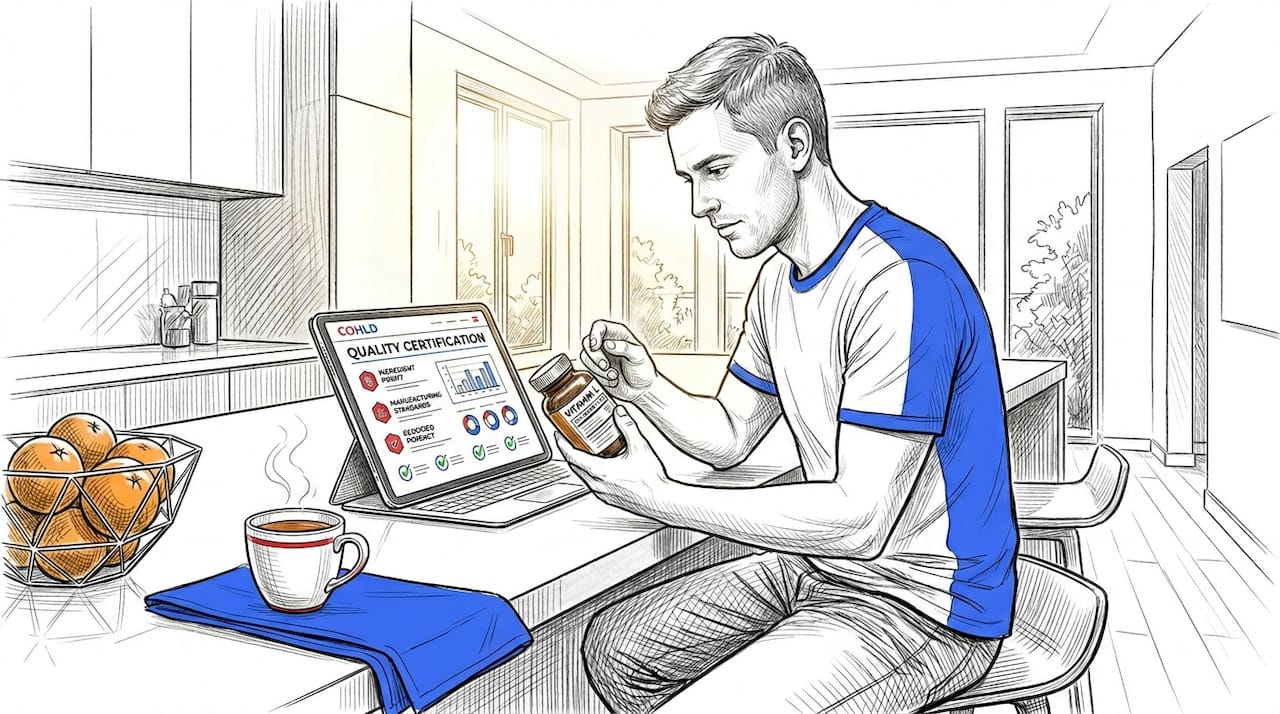
Certifications from organizations like USP, NSF International, and ConsumerLab mean a supplement has been tested beyond FDA regulation for ingredient identity, potency, purity, and manufacturing quality. These are not rubber stamps. Each certification requires rigorous lab analysis, and products can fail.
Here is what these seals actually verify:
- USP Verified: Confirms correct ingredients at labeled amounts, no harmful contaminants, and proper dissolution so the product actually absorbs.
- NSF Certified for Sport: Verifies the absence of over 270 banned substances alongside purity and label accuracy.
- ConsumerLab Approved: Independent lab testing for ingredient accuracy and contamination.
Pro Tip: Look for the certification seal directly on the product packaging, and verify it on the certifying organization’s website. Brands sometimes use certification-style logos that are not official.
2. Vague label claims are a red flag, not a selling point
A supplement that uses phrases like “100% pure,” “all-natural,” or “proprietary blend” without independent backing is telling you something important. It is telling you to look closer.
“Natural” labels are frequently misleading without proof of testing or certification. The word has no regulated definition in the supplement space. It can appear on products that contain synthetic fillers, artificial colorings, or contaminated raw materials.
Proprietary blends are a particular concern. When a product lists a blend with a total weight but not individual ingredient amounts, you have no way to verify whether the active ingredient is present at an effective dose or barely included at all. Transparent labeling is a core characteristic of quality supplements.
Watch for these warning signs on any label:
- Ingredient amounts hidden under a blend name
- No listed manufacturer name or contact information
- No lot number or expiration date
- Claims of efficacy not supported by any cited research
- Missing country of origin for raw materials
Understanding how to read supplement labels critically is one of the most practical skills you can develop as a supplement buyer.
3. Recent recalls signal serious purity failures
Recalls are not just bureaucratic events. They are evidence that a product that passed quality inspection still reached consumers with dangerous flaws. Tracking recall history for a brand or product is one of the most underused tools for identifying impurity risks.
In May 2026, a liquid B-complex vitamin was recalled after contamination with black particulate matter was found in over 4,000 bottles. The FDA classified this as a Class II recall, meaning the product could cause adverse health effects.
| Recall class | Risk level | What it means |
|---|---|---|
| Class I | High | Reasonable probability of serious harm or death |
| Class II | Moderate | May cause adverse health consequences but not necessarily life-threatening |
| Class III | Low | Unlikely to cause harm but violates regulations |
“A Class II recall should not be dismissed as minor. For vulnerable individuals, contamination that causes temporary harm can still lead to lasting consequences.” — FDA recall guidance framework
You can search the FDA’s recall database at fda.gov and sign up for email alerts. Check a brand’s recall history before buying, not just once but periodically if you use a product long term.
4. Adulteration in specific supplement types is more common than you think
Some supplement categories carry higher adulteration risk than others. Essential oils marketed as dietary supplements are a clear example of where purity claims frequently fall apart under testing.
A 2026 analysis found that only 3 of 28 lavender oil brands tested on Amazon met ISO authenticity standards with no adulteration detected. The findings were striking: 55% showed non-authentic chemical profiles, 60% were diluted with carrier oils, and 65% contained synthetic compounds.
| Adulteration type | How common in tested samples | Why it matters |
|---|---|---|
| Non-authentic chemical profile | 55% | Does not match the plant source claimed |
| Dilution with carrier oils | 60% | Reduces potency and effectiveness |
| Synthetic compound presence | 65% | May trigger sensitivities or reduce therapeutic value |
The same principle applies to fish oils, herbal extracts, and protein powders. Adulteration commonly occurs in expensive or popular products where cutting with cheaper materials is profitable. ISO standards and verified chemical profiling exist specifically to catch this.
Pro Tip: For essential oils and herbal extracts, search for GC/MS (gas chromatography/mass spectrometry) test results from the brand. Reputable companies publish these. If they do not, that is worth noting.
5. Purity extends to how a supplement is manufactured
Supplement purity is not absolute. It includes not just what ingredients are present but whether the product is manufactured in a way that prevents contamination, maintains potency, and delivers ingredients effectively.
Look for these manufacturing quality signals when researching a brand:
- Current Good Manufacturing Practices (CGMP) compliance: This FDA standard covers facility conditions, equipment sanitation, testing procedures, and record-keeping. Brands sourcing from CGMP-certified facilities meet a defined baseline.
- Dissolution testing: A tablet that does not dissolve properly in your digestive system does not deliver its nutrients. Dissolution testing ensures that active ingredients are released efficiently for absorption, which is a non-negotiable element of nutritional supplement purity.
- Batch testing: Batch testing involves representative sampling of manufacturing lots to check for prohibited substances and contaminants. It reduces risk significantly, though it does not eliminate it entirely.
US-based manufacturing under CGMP standards is one reason why sourcing supplements domestically often correlates with stronger quality control.
6. Cross-contamination and undeclared substances are hidden purity risks
Even a well-intentioned manufacturer can introduce contaminants through shared equipment or poor storage practices. Labels may hide ingredients under proprietary blends, and batch testing reduces but does not eliminate the risk of undeclared or prohibited substances reaching consumers.
This is especially relevant if you take supplements for athletic performance or have food sensitivities. Allergen cross-contamination, heavy metals from raw material sourcing, and pesticide residues are all real concerns that do not show up on standard labels. Learning to avoid synthetic fillers is a good starting point, but full purity requires verifying the entire supply chain.
7. A practical checklist for identifying pure supplements
Putting all the signs of pure supplements together into a repeatable process makes the decision far less overwhelming. Use this set of criteria every time you evaluate a new product or brand.
- Does the product carry a USP, NSF, or ConsumerLab certification seal, verified on the certifier’s website?
- Does the label disclose every ingredient with individual amounts, including fillers and flow agents?
- Has the brand had any FDA recalls in the past three years?
- Does the manufacturer operate from a CGMP-certified facility, ideally US-based?
- Are batch test results or certificates of analysis publicly available or provided on request?
- Does the brand publish third-party lab results for potency, contaminants, and dissolution?
If you can answer yes to most of these, you are looking at a product that meets the real characteristics of quality supplements. If a brand deflects or cannot answer these questions, that tells you something too.
My honest take on supplement purity standards
I have spent years paying close attention to how supplements are made, labeled, and sold. What I have seen is that the majority of consumers are making purchasing decisions based on packaging design and marketing copy, not verified quality data. That is not their fault. The industry has made it easy to feel informed while remaining largely in the dark.
What changed how I think about purity was learning that third-party certification is not just a nice add-on. It is the only real external check on an industry where self-reporting is the default. I now treat the absence of certification as a genuine red flag, not just a neutral omission. The risks of ignoring purity signs are not theoretical. Contamination events happen with real products, bought by real people who trusted a label.
My advice: prioritize transparency and verification above everything else, including price and brand recognition. A supplement that costs less but skips third-party testing is not a bargain.
— Justin
Clean supplements built on real purity standards
If you have been applying these criteria and finding most shelves come up short, Cohld was built for exactly that frustration. Every product in the Cohld supplements collection is formulated without synthetic fillers, artificial additives, or hidden ingredients, sourced from grass-fed, pasture-raised animals and manufactured in US-based, GMP-compliant facilities.

From grass-fed collagen peptides to magnesium glycinate and NAD+, each product reflects the same purity criteria covered in this article: transparent labeling, clean sourcing, and a commitment to what actually goes into your body. If the standards here matter to you, they are the same standards Cohld holds itself to.
FAQ
What are the main signs of pure supplements?
The clearest signs include third-party certification seals from USP, NSF, or ConsumerLab, fully transparent ingredient lists without proprietary blends, and a clean recall history with the FDA.
Are “all-natural” or “100% pure” labels reliable indicators?
No. These terms are unregulated and frequently misleading without accompanying certification or third-party lab testing to back up the claim.
What certifications should I look for on supplements?
Look for USP Verified, NSF Certified, or ConsumerLab Approved seals. These organizations conduct independent testing for ingredient accuracy, contaminants, and manufacturing quality beyond what FDA oversight requires.
How does manufacturing quality affect supplement purity?
CGMP-compliant manufacturing addresses facility conditions, contamination prevention, and batch consistency. Dissolution testing also confirms that active ingredients are actually released and absorbed, making it a critical but often overlooked part of true purity.
Where can I check if a supplement has been recalled?
The FDA maintains a searchable recall database at fda.gov where you can look up products and brands by name, and sign up for recall alerts to stay current.