

Most supplements on store shelves are not regulated the way drugs are. That gap creates a real problem. Knowing how to optimize supplement purity is not just a concern for elite athletes or biohackers. The FDA has identified over a thousand tainted dietary supplements containing hidden dangerous ingredients linked to serious injuries and deaths. If you are spending real money on collagen peptides, magnesium glycinate, or NAD+ expecting results, you need to know whether what is in the bottle matches what is on the label. This guide gives you the exact steps to verify that.
Table of Contents
- Key takeaways
- How to optimize supplement purity before you buy
- Step-by-step process to verify supplement purity
- Common mistakes that undermine purity efforts
- What proper purity verification actually delivers
- My take on the purity problem nobody talks about
- Clean supplements from Cohld, built for verification
- FAQ
Key takeaways
| Point | Details |
|---|---|
| Third-party certification is non-negotiable | Look for NSF, USP, or ConsumerLab seals and verify them in official online directories. |
| Batch-level COAs matter most | Always match the Certificate of Analysis to the specific lot number on your product. |
| GMP compliance protects you after manufacturing | Proper holding and distribution controls prevent contamination between factory and your hands. |
| Red flags are everywhere | Fake seals, missing batch numbers, and refusals to share lab data are disqualifying. |
| Purity and bioavailability are linked | A contaminated or mislabeled supplement cannot deliver the absorption outcomes you expect. |
How to optimize supplement purity before you buy
Before you open a single bottle, you need a checklist. The supplement industry is largely self-regulated at the point of sale, which means consumers must default to evidence-based verification rather than trusting brand marketing.
The certification seals worth trusting
Three organizations dominate legitimate third-party testing: NSF International, USP, and ConsumerLab. Each runs independent programs that go beyond what a brand’s own lab would produce. NSF certification includes facility inspections, product testing, and ongoing surveillance. That ongoing piece matters. A product can pass a one-time test and slip later. Continuous programs catch that drift.
For athletes or anyone sensitive to contaminants at trace levels, NSF Certified for Sport takes it further. It screens for over 290 banned substances and contaminants and is recognized by major sports organizations worldwide. This is a meaningful step up from standard certification.
Here is what to look for when evaluating a supplement’s certifications:
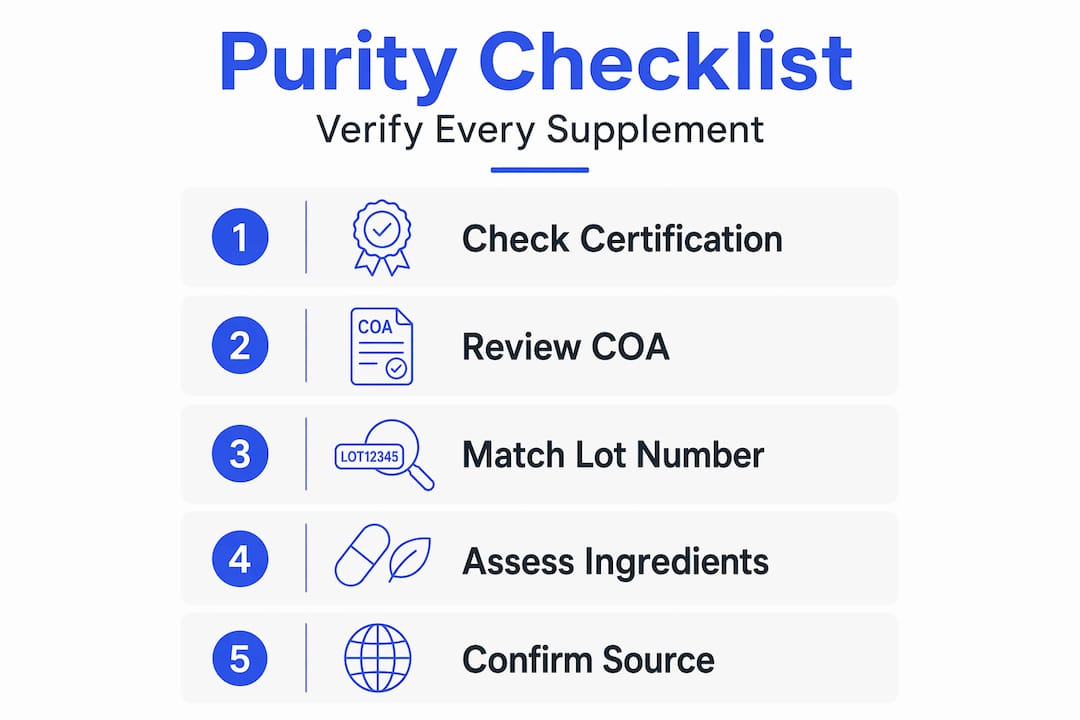
- Verify the seal independently. Check the NSF mark via their online directory or app. Do not trust a logo printed on a label without confirming it.
- Confirm GMP compliance. Products manufactured under FDA-regulated Current Good Manufacturing Practices (CGMPs) have documented quality controls at every production stage.
- Check the Supplement Facts panel carefully. Look for batch numbers, expiration dates, and a full ingredient list with no vague proprietary blends hiding quantities.
- Research the brand’s manufacturing location. US-based, GMP-compliant facilities operate under FDA oversight. Overseas manufacturers may not meet the same standards.
Pro Tip: When you see “manufactured in a GMP-certified facility” on a label, ask which certifying body issued that certification. “Self-certified” GMP means very little.
Understanding why to prioritize purity in supplements starts with recognizing that a clean ingredient sourced poorly can still deliver a contaminated product.
Step-by-step process to verify supplement purity
Knowing what to look for is one thing. Knowing how to actually confirm it before you spend money is another. Follow these steps:
- Locate the lot number on the product. It is usually printed on the bottom or side of the bottle. Every legitimate product has one.
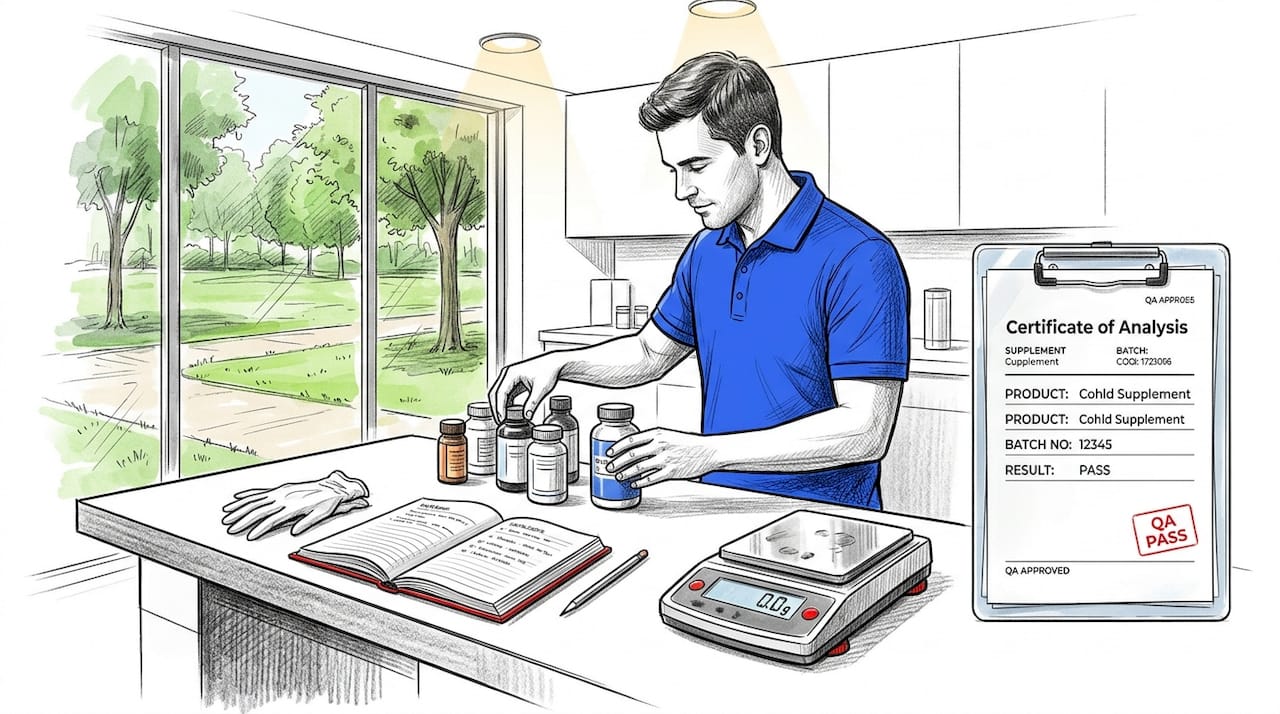
- Request or download the batch-specific Certificate of Analysis (COA). A COA should include the product name, batch number, test date, testing lab name, methods used, results, and acceptable ranges. Matching a batch COA to your lot number is the single most reliable verification step available to consumers.
- Confirm the testing lab is ISO-accredited. Any third-party lab worth using holds ISO 17025 accreditation. This is the international standard for testing laboratory competence.
- Cross-reference certifications in official directories. NSF, USP, and ConsumerLab each maintain searchable databases. If a product is not listed, treat that absence as a red flag.
- Contact the brand directly. Ask for their lab accreditation documentation and whether batch testing is performed on every production run or only periodically.
The table below summarizes what a legitimate COA must contain versus what a suspicious one often omits:
| COA Element | Legitimate Document | Red Flag |
|---|---|---|
| Batch/lot number | Matches product label exactly | Generic or missing |
| Testing lab name | ISO 17025-accredited lab listed | Unnamed or brand’s own lab |
| Test date | Recent, within product shelf life | Undated or several years old |
| Contaminant results | Specific values with acceptable limits | “Passed” with no numerical data |
| Certifier signature | Authorized lab technician signed | No signature or authorization |
Pro Tip: If a brand’s website does not publicly post COAs and customer service takes more than 48 hours to send one on request, that delay itself is informative. Brands with nothing to hide share this data readily.
For a broader framework on how to check bioavailability and source quality together, Cohld’s clean supplement checklist walks through the full evaluation criteria.
Common mistakes that undermine purity efforts
Even health-conscious consumers make these errors, sometimes repeatedly. Avoiding them is as important as following the right steps.
- Trusting label claims without verification. Marketing language like “ultra-pure” or “pharmaceutical grade” has no regulated definition. Anyone can print it.
- Relying on brand reputation over batch data. A brand can produce excellent products most of the time and still have a contaminated lot. Purity and contaminant control can vary by lot, which is exactly why batch-level COAs exist.
- Ignoring post-manufacturing controls. FDA CGMP guidance stresses sanitation, pest control, temperature, and humidity controls throughout holding and distribution. A pristine product shipped in a hot, uncontrolled warehouse can degrade or become contaminated before it reaches you.
- Accepting fake or unverifiable seals. Some products display third-party-style logos that are entirely fabricated. If you cannot find the product in an official certifier database, the seal means nothing.
“Dietary supplements sold in the U.S. are not required to be proven safe or effective before they reach store shelves. The burden of verification falls on the consumer.”
This reality makes purity verification an active responsibility, not a passive one. Understanding the difference between natural and synthetic supplements also helps you ask better questions about what actually belongs in a formula.
What proper purity verification actually delivers
Doing this work pays off in ways that go beyond avoiding bad products. When you consistently choose supplements with verified purity, several outcomes improve noticeably.
The most direct benefit is safety. Removing contaminated or mislabeled products from your routine eliminates exposure to hidden stimulants, heavy metals, and pharmaceutical adulterants. The FDA lab analyses identified tainted products across multiple popular categories, including weight loss and bodybuilding supplements, meaning no category is inherently safe by reputation alone.
Beyond safety, there is efficacy. If you are working to optimize bioavailability, a supplement that contains less active ingredient than labeled, or one contaminated with compounds that interfere with absorption, will consistently underperform. Learning how to optimize supplement absorption starts with knowing what you are actually ingesting. Verified purity aligns the label with the contents, which is the baseline requirement for any absorption strategy to work.
The cost argument is also real. Ineffective or unsafe supplements waste money. Spending slightly more on a verified, GMP-manufactured product eliminates the cost of products that deliver no benefit or cause harm that requires addressing.
My take on the purity problem nobody talks about
I have spent years looking at how the supplement industry communicates purity to consumers, and the honest truth is that most of the conversation stops at the brand level. Certifications get mentioned, GMP gets a nod, and then the discussion ends. What rarely gets discussed is batch-level variation.
In my experience, this is where consumers get burned. A brand can be genuinely committed to quality and still ship a lot that has a contamination event from a raw material supplier, a packaging error, or a distribution failure. The only way to catch that is batch-specific COA verification. Not brand reputation. Not a general certification. The specific lot you hold in your hand.
I also think the industry has made real progress on transparency, particularly among smaller, direct-to-consumer brands that stake their reputation on ingredient integrity. But the mainstream supplement market still relies on consumers not asking hard questions. The tools to verify purity have never been more accessible. What is still missing is the habit of using them.
My advice: treat batch verification the way you treat checking a restaurant’s health inspection score. It takes two minutes. It catches real problems. And it shifts the burden back to brands to stay accountable at every production run, not just when things are going well.
— Justin
Clean supplements from Cohld, built for verification

Cohld was built around the principle that transparency is not a marketing claim. It is a practice. Every supplement in the Cohld collection is sourced from grass-fed, pasture-raised animals, manufactured in US-based, GMP-compliant facilities, and formulated without synthetic fillers, artificial additives, or hormone disruptors. That sourcing standard is the foundation. But the commitment to batch-level accountability is what makes it meaningful for consumers who have done the work to understand purity. Explore Cohld’s clean nutrition products and see exactly what goes into each formula before you order.
FAQ
What does purity in supplements actually mean?
Purity in supplements means the product contains exactly what the label states, with no undisclosed ingredients, contaminants, or adulterants. It covers both ingredient accuracy and the absence of harmful compounds introduced during manufacturing or distribution.
How do I verify a supplement’s Certificate of Analysis?
Request the batch-specific COA from the brand and confirm the lot number matches your product. The COA should come from an ISO 17025-accredited lab and include specific numerical results, not just a “passed” notation.
Is GMP certification enough to guarantee supplement purity?
GMP compliance sets the manufacturing process standard, but it does not replace batch-level testing. FDA CGMP guidance covers environmental controls and sanitation but purity is confirmed through independent lab testing of the finished product.
What is NSF Certified for Sport and do I need it?
NSF Certified for Sport screens for over 290 banned substances and contaminants and is designed for athletes or anyone with strict contamination concerns. For general consumers, standard NSF or USP certification provides strong purity assurance.
How does supplement purity affect bioavailability?
A contaminated or under-dosed supplement cannot deliver expected absorption outcomes regardless of the delivery format. Confirming purity is the prerequisite step before working to optimize bioavailability, since the formula must match the label for any absorption strategy to function correctly.

