

The word “natural” sells. It appears on supplement bottles, skincare jars, and wellness blogs with an air of automatic trustworthiness. But here’s the thing: “natural” has no regulated definition in the supplement or cosmetics industry, which means any brand can use it freely. Dermatologists consistently point out that natural labels can mislead consumers into assuming safety and superiority that the ingredient itself may not actually deliver. If you care about purity, ancestry-informed wellness, and evidence-backed choices, you deserve a clearer picture than a label can offer.
Table of Contents
- What does ‘natural’ actually mean for ingredients?
- The science and evidence behind natural ingredients
- When are natural ingredients truly effective (and safe)?
- How to choose and use natural ingredients wisely
- Why ‘natural’ isn’t everything: Our take for the conscious consumer
- Explore cleaner choices for supplements and skincare
- Frequently asked questions
Key Takeaways
| Point | Details |
|---|---|
| Not all natural is safe | The label ‘natural’ does not guarantee safety—always check ingredient research and product transparency. |
| Science matters most | Choose natural products with human evidence and standardized formulations for best results. |
| Smart selection is key | Evaluate ingredients, look for certifications, and test new products for your unique needs. |
| Transparency builds trust | Brands that share sourcing, testing, and formulation details are more reliable choices. |
What does ‘natural’ actually mean for ingredients?
The honest answer is: it depends on who you’re asking. In marketing, “natural” often means the product contains at least one plant-derived ingredient. In science, it means very little without specifying the compound, its concentration, its source, and how it was processed. These two definitions live in completely different worlds.
There is no FDA or FTC standard that requires a product to meet a specific threshold before it earns the “natural” label. A cream with 98% petrochemicals and 2% lavender water can legally call itself natural-inspired. That gap between perception and reality is where health-conscious consumers get burned. Learning about clean supplements and wellness requires looking beyond the front label entirely.
Common misconceptions about natural products include:
- Natural automatically means non-toxic or hypoallergenic
- Synthetic ingredients are always inferior or harmful
- Plant-derived means the same as minimally processed
- Traditional use alone validates modern health claims
- Higher price reflects higher purity or potency
“Dermatologists caution that ‘natural’ and ‘hypoallergenic’ are not synonymous. These terms are unregulated and can appear on products that still contain known allergens or irritants.” — Everyday Health
This is why it matters to avoid synthetic supplements based on specific ingredient knowledge, not just broad labels. The goal isn’t to reject all synthetic compounds blindly or trust all natural ones uncritically. It’s to build a smarter filter.
The science and evidence behind natural ingredients
Science doesn’t judge an ingredient by its origin story. It judges by mechanism, bioavailability, and measurable outcomes in controlled human studies. And when you apply that standard, the picture for natural ingredients gets genuinely interesting.
Research shows that nutraceuticals vary widely in their evidence base. Some plant-derived compounds, such as vitamin C from rosehip, ceramides from plant fermentation, and hyaluronic acid found in connective tissue, have solid clinical backing. Others, including many trendy botanical extracts, rest almost entirely on in-vitro (cell culture) studies that do not translate reliably to human skin or systemic health. For instance, oral sodium hyaluronate has demonstrated measurable improvements in skin hydration in controlled trials, making it one of the better-supported natural compounds in oral skincare science.

Here’s a quick look at where popular natural ingredients stand:
| Ingredient | Source | Evidence level | Primary benefit |
|---|---|---|---|
| Collagen peptides | Bovine/marine tissue | Strong (multiple RCTs) | Skin elasticity, joint support |
| Hyaluronic acid | Microbial fermentation | Strong (clinical trials) | Skin hydration |
| Vitamin C (ascorbic acid) | Citrus/synthetic-identical | Strong | Antioxidant, collagen synthesis |
| Maca root | Andean plant | Moderate | Hormonal balance, energy |
| Turmeric (curcumin) | Root spice | Moderate (absorption challenges) | Anti-inflammatory |
| Tallow (grass-fed) | Bovine fat | Traditional + emerging | Skin barrier, fat-soluble vitamins |
| Charcoal | Activated plant carbon | Limited clinical data | Topical detox, pore cleansing |
How to assess whether a natural ingredient actually has credibility:
- Look for peer-reviewed, human clinical trials, not just animal or cell studies.
- Check whether the study used the same form and dose as the product you’re evaluating.
- Confirm that traditional use aligns with (rather than contradicts) modern evidence.
- Identify whether the benefit is topical, systemic, or both, as delivery route matters enormously.
- Check for evidence-backed natural supplements that disclose specific standardized extracts.
Pro Tip: When reading a supplement study, check the funding source and study size. A well-funded, double-blind trial with 100 or more participants in a reputable journal outweighs a 20-person open-label study every time.
Understanding the science of natural skincare means accepting that evidence quality is a spectrum, not a binary. The best natural products combine traditional credibility with modern validation.
When are natural ingredients truly effective (and safe)?
Effectiveness and safety aren’t the same conversation, though they’re often treated as one. A natural ingredient can be highly effective and still pose risks for certain skin types, just as a synthetic ingredient can be rigorously safe but offer minimal benefit. The real question is always: effective and safe for whom, in what formulation, and at what dose?
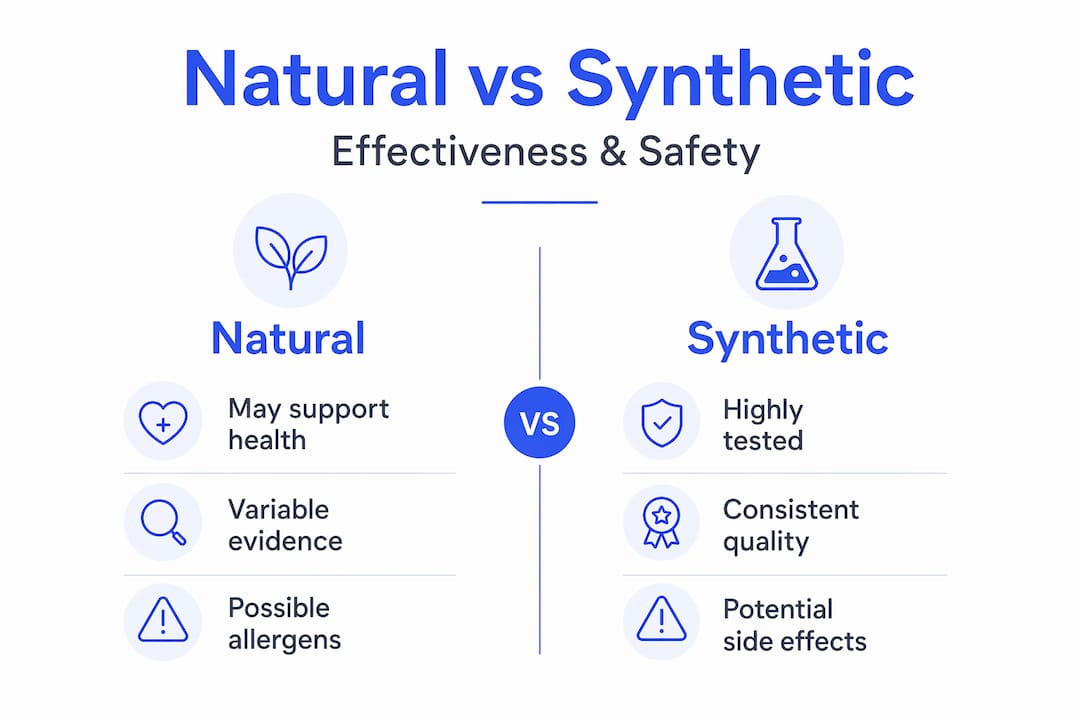
Research confirms that plant bioactive compounds can support multiple skin care objectives simultaneously, including hydration, antioxidant protection, and barrier repair, but formulation quality and standardization determine whether those bioactives actually survive processing and reach the target tissue in sufficient concentrations.
| Factor | Natural ingredient | Synthetic ingredient |
|---|---|---|
| Evidence base | Varies widely | Often more controlled |
| Stability in formula | Can degrade faster | Generally more stable |
| Allergy risk | Present (esp. botanicals) | Present (esp. preservatives) |
| Bioavailability | Depends on form and source | Often engineered for absorption |
| Transparency | Varies by brand | Varies by brand |
Key risk factors to watch for in natural products:
- Essential oils at high concentrations are among the most common contact allergens in skincare.
- Botanical extracts without standardization may deliver inconsistent active compound levels batch to batch.
- Fermented ingredients, while often highly bioavailable, can cause reactions in histamine-sensitive individuals.
- Unverified sourcing from non-GMP facilities increases contamination and potency risks.
Pro Tip: Choose brands that share Certificate of Analysis (COA) documents from third-party labs. This one document tells you more about product quality than any front-label claim. Prioritize improving skin bioavailability through well-formulated products rather than high-marketing ones. And remember that avoiding synthetic fillers requires reading the full ingredient list, every time, not just the highlighted naturals on the front.
How to choose and use natural ingredients wisely
Having the science is useful. Applying it in a grocery aisle or on a product page is where most people need practical help. Here’s a framework that works.
Steps for evaluating any natural supplement or skincare product:
- Identify the active ingredient. What compound is actually doing the work? Collagen peptides. Magnesium glycinate. Ceramides. The active should be clearly named.
- Review the evidence for that specific ingredient. Not the category. Not a vague herb family. The exact compound in the exact dose range.
- Confirm the formulation is standardized. Especially for plant extracts, look for standardized percentages (e.g., 95% curcuminoids) rather than generic herb powder.
- Assess allergen risk. Does it contain essential oils, fragrances, or botanicals you’ve reacted to before?
- Check sourcing and certifications. GMP facility, grass-fed sourcing for animal-derived ingredients, and third-party testing are non-negotiable for truly clean products.
Signs that a brand is worth trusting include:
- Full ingredient list with no proprietary blend hiding quantities
- Named supplier or country of origin for key actives
- Published third-party test results or COA availability
- No fragrance or filler padding the formula
“When choosing natural products, look past the label and evaluate what the active ingredient is, whether there’s human evidence for it, and whether the product avoids common irritants—because ‘natural’ alone is not a safety guarantee.” — Everyday Health
When trying a new supplement, start at the lower end of the suggested dose for the first week. For new skincare, perform a 24-hour patch test on your inner forearm before full application. Even well-sourced, science-backed natural supplements can occasionally cause unexpected individual responses, particularly if you have underlying sensitivities or are taking other compounds.
Why ‘natural’ isn’t everything: Our take for the conscious consumer
We’re going to say something that might surprise you: some synthetic ingredients are genuinely safer and more effective than their natural counterparts. Synthetic vitamin E (tocopherol) is often more stable in formulas. Lab-derived hyaluronic acid has a more consistent molecular weight than animal-sourced versions. Some experts argue that the natural vs. synthetic debate is less useful than asking about specific ingredient identity, testing rigor, and formulation quality.
We believe in the power of ancestral ingredients, including grass-fed tallow, collagen from pasture-raised animals, and whole-food-sourced minerals, not because they’re natural, but because their origin and processing method genuinely affect their nutrient density, fatty acid profile, and bioavailability. Grass-fed tallow carries fat-soluble vitamins A, D, E, and K in ratios that mirror human sebum. That’s a biological argument, not a marketing one.
True purity isn’t a claim. It’s a practice. It means sourcing from farms you can verify, manufacturing in GMP-certified facilities, and submitting every batch to third-party testing. It means telling you exactly what’s in the product and exactly where it came from. Explore more on science, purity, and results if you want to go deeper on what clean actually looks like when a brand takes it seriously.
Explore cleaner choices for supplements and skincare
Reading ingredient labels is one thing. Finding brands that actually live up to the standard is another.

At Cohld, every product starts with the same question: can we trace this ingredient to its source, prove its quality with third-party testing, and demonstrate its benefit with real evidence? Our clean supplements line covers collagen peptides, magnesium glycinate, creatine, and the Bedrock shilajit complex, all sourced from US-based, GMP-compliant facilities with no synthetic fillers or artificial additives. On the skincare side, our natural skin firming cream combines grass-fed tallow with purposeful actives, formulated for real skin barrier support. If you’re ready to move past labels and into products that earn your trust, this is where to start.
Frequently asked questions
Are natural ingredients always safe for sensitive skin?
No. Natural ingredients can trigger allergies or irritation just like synthetic ones, so always review the full ingredient list and perform a patch test before full use.
Do natural supplements actually work better than synthetic ones?
Not automatically. Evidence varies widely by ingredient, so effectiveness depends on the specific compound, its dose, its form, and the quality of the study behind it.
How do I know if a ‘natural’ product is truly clean?
Look for complete ingredient disclosure, named sourcing, third-party lab certifications, and GMP manufacturing standards. Marketing language alone is not enough.
Can plant-based skincare cause allergic reactions?
Yes. Plant-derived ingredients can and do cause reactions, especially essential oils and unstandarized botanical extracts, so always patch test and introduce one new product at a time.